Band Heater
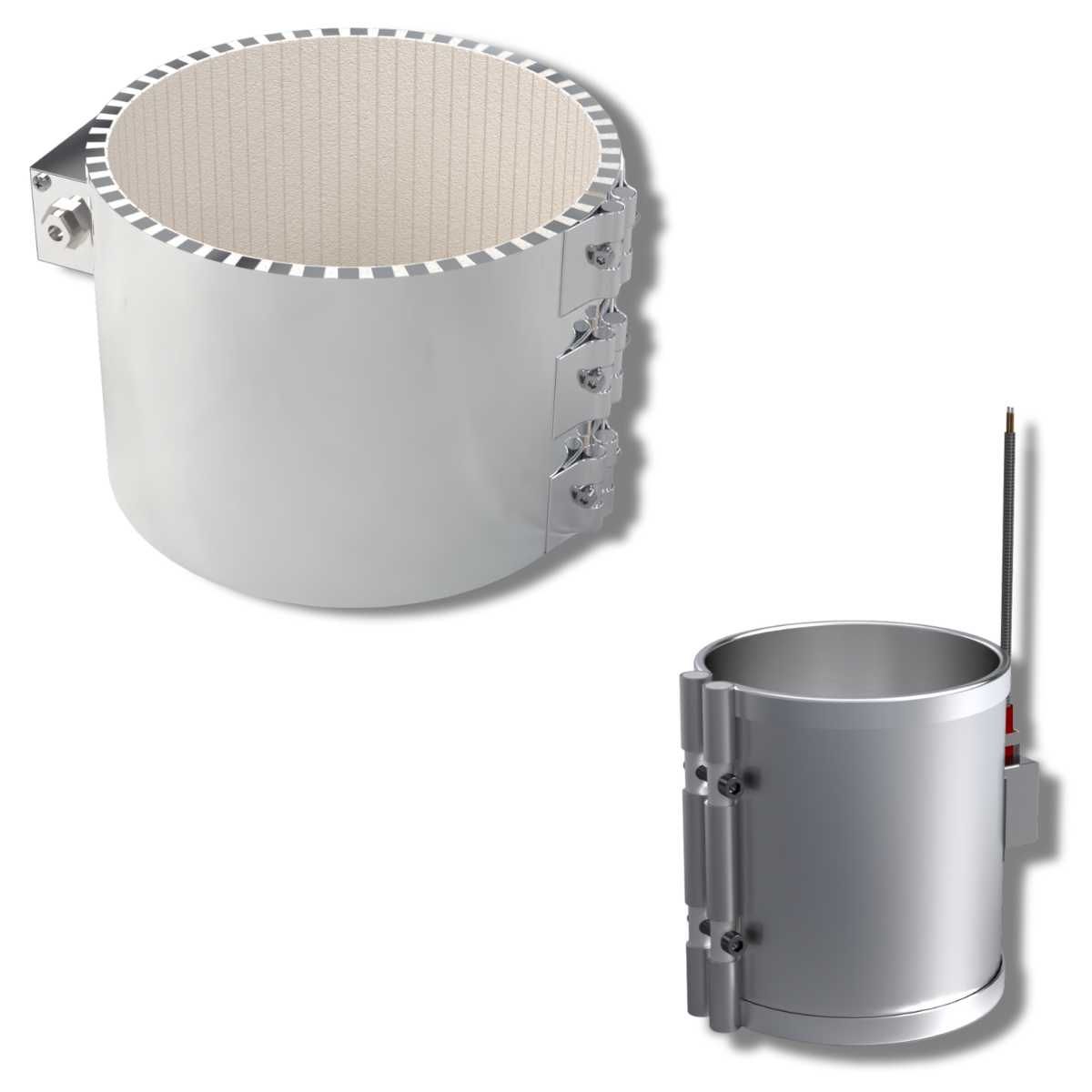
A band heater is a ring-shaped element that clamps around a cylinder and heats it through its wall. Resistance wire sits on mica or inside a ceramic body, wrapped in a stainless steel band that is pulled tight by a clamp. It is the element that heats injection barrels, extruder zones, nozzles and pipes.
- Max temperature
- 450 (mica) to 650 (ceramic) °C
- Inner diameter
- 20 to 500 mm
- Width
- 20 to 200 mm
- Watt density
- 3 to 8 W/cm²
- Voltage
- 220 / 380 V
- Custom builds
- Any diameter, width and cut-out
Ask for a Price or Technical Advice
Call us or send a WhatsApp message for a price, full specifications, or a custom build.
Technical Specifications
The figures below are the usual ranges for this type of element. Builds outside them are possible.
| Property | Value |
|---|---|
| Construction | Resistance wire on mica or set in ceramic bricks, inside a stainless steel band |
| Band material | Stainless 304 or stainless 321 |
| Max working temperature | 450 (mica) to 650 (ceramic) °C |
| Inner diameter range | 20 to 500 mm |
| Width range | 20 to 200 mm |
| Safe watt density | 3 to 8 W/cm² |
| Clamping | Barrel nut, wedge lock, or latch and strap |
| Working voltage | 220 single phase or 380 three phase V |
| Termination | Post terminals, fibreglass leads with stainless braid, or a European box |
| Cut-outs | Holes and notches for thermocouples, nozzles and lugs |
| Insulation option | Ceramic fibre jacket over the band |
| Power tolerance | +5 to -10 % |
Where It Is Used
- Plastic injection moulding
- Packaging machinery
- Food and pharmaceutical machinery
- Extruder and blow-moulding barrels
- Hot runner nozzles and manifolds
- Pipe and cylinder heating
Choosing, Fitting and Looking After It
The clamp is the element’s cooling system
A band heater has nothing to heat but the barrel it is touching. Anywhere the band lifts off the surface, the heat has nowhere to go, and that spot climbs until the wire inside gives up. Almost every early failure is a contact failure, and it is visible: pull the dead heater off and look for a discoloured patch on the inside. That patch is where it was not touching.
So the clamp is not a fastening, it is part of the thermal design. Pull it up evenly, close the gap, and check the barrel is actually round — an old barrel that has been through a few heaters is often oval by a millimetre or two, and no band will sit flat on it.
Re-tighten after the first heat cycle. Every time
The band expands as it comes up to temperature and settles. A clamp that was tight cold is loose hot, and then loose cold as well. Fit the heater, run the machine up to working temperature, shut it down, and go round the clamps again. Skipping this one step is the single most common reason a new band heater does not last.
Clean the barrel before fitting
Plastic that has leaked and carbonised, old scale, or a scored ridge left by a previous heater all sit between band and barrel like insulation. Take the barrel back to bare metal where the heater will sit. Do not fill a dent with anything — paste, foil and shim material all change what the contact does as it heats.
Cut-outs are part of the order, not an afterthought
Thermocouple bosses, nozzle bodies, tie-bar heads and lifting lugs all take up room on the barrel. Cutting a notch into a finished band heater with a grinder cuts the resistance wire or the mica behind it. Say where every obstruction is when ordering, with its distance from the end of the band, and the heater is built around them.
Losing heat to the workshop
A bare band heater sends heat outwards as readily as inwards. On a machine that runs continuously, a fibre jacket over the band pays for itself in weeks — the zone holds temperature more steadily, the controller cycles less, and the surface stops being a burn risk for whoever works next to it.
Read the zone, not the setpoint
If one zone is always struggling to reach its setpoint while its neighbours are fine, the fault is rarely the controller. It is one heater in that zone with a poor clamp, or a thermocouple that has worked loose in its hole and is reading the air. Before ordering more power for a zone, check what its sensor is actually touching.
Price
Price
The price for this product depends on the specification you order.
What Sets the Price
- Diameter and length
- Power and voltage needed
- Sheath material (stainless steel, brass and so on)
- Termination type and lead or thread length
- Whether a thermocouple is built in
- Order quantity
How It Compares
The three types in this family, and what decides between them.
| Feature | Mica band | Ceramic band | Nozzle heater |
|---|---|---|---|
| Max temperature | Up to 450 °C | Up to 650 °C | Up to 650 °C |
| Response | Fast | Slower, holds heat | Fast, small mass |
| Where it fits | Barrels and cylinders | Barrels running hot | Small diameters and nozzles |
| Efficiency | Good contact needed | Radiates as well as touches | Wraps a short, tight zone |
Common Questions
How do I measure for a band heater?
Measure the outside diameter of the barrel with a caliper or a tape around it, then the width of the space available, and note where anything gets in the way — a thermocouple hole, a bolt head, a nozzle. Those become the cut-outs. Inner diameter of the heater matches the outer diameter of the barrel.
Mica or ceramic — which should I order?
Mica below about 450 °C. It is thinner, cheaper and heats quickly. Ceramic above that, up to about 650 °C, and where the machine runs continuously — it stands more heat and its ceramic body keeps working even when contact with the barrel is less than perfect.
My band heater burns out every few months. Why?
Nearly always the clamp. If the band is not pulled tight all the way round, the heat has nowhere to go at the loose spot and the wire fails there. Check that the barrel is round and clean, that the clamp closes fully, and that the heater was re-tightened after its first heat cycle.
Can a heater be made in two halves?
Yes, and for large diameters it is the normal way. Two half-bands hinged or bolted together fit around a barrel that cannot be slid off, and either half can be replaced on its own. It also makes fitting possible in a machine with no clearance at the ends.
Is an insulating jacket worth it?
On a machine that runs all day, yes. Most of the heat a bare band heater loses goes into the workshop air, not into the barrel. A ceramic fibre jacket over the band cuts that loss, holds the zone temperature steadier and lowers the surface temperature the operator can touch.
Can you build to a burnt-out heater with no label?
Yes. The inner diameter, the width, the position of the cut-outs and the way the leads leave the band are all measurable from the old one. Voltage comes off the machine plate. If the wire is not broken open, its resistance gives the wattage.
Types in This Family
Mica Band Heater
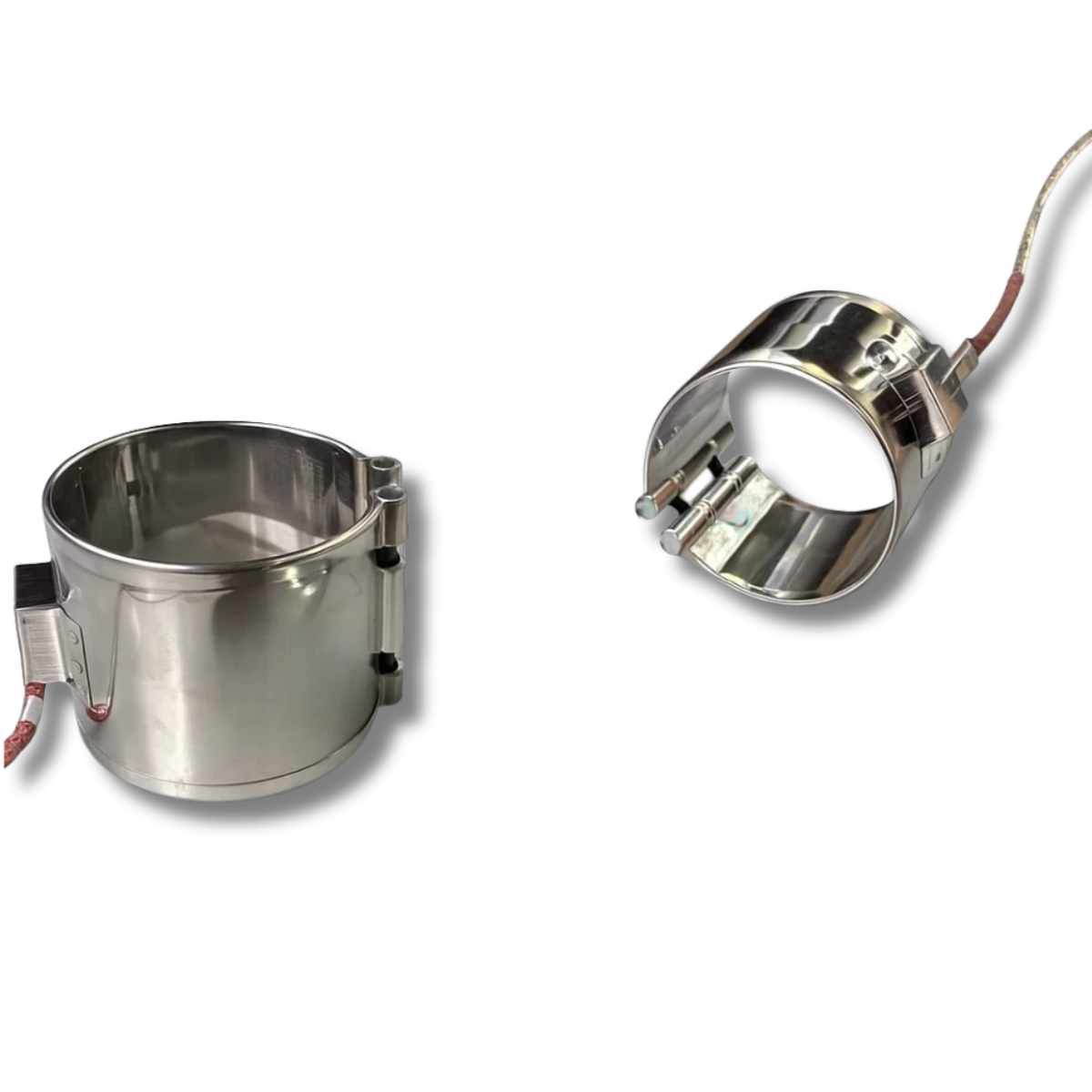
A mica band heater is the thin, fast type of band heater. Flat nickel-chrome ribbon is wound over a mica sheet, covered with more mica and closed inside a stainless steel band about three millimetres thick. It heats an injection barrel quickly and cheaply, and we supply it for working temperatures up to 300 °C.
Ceramic Band Heater
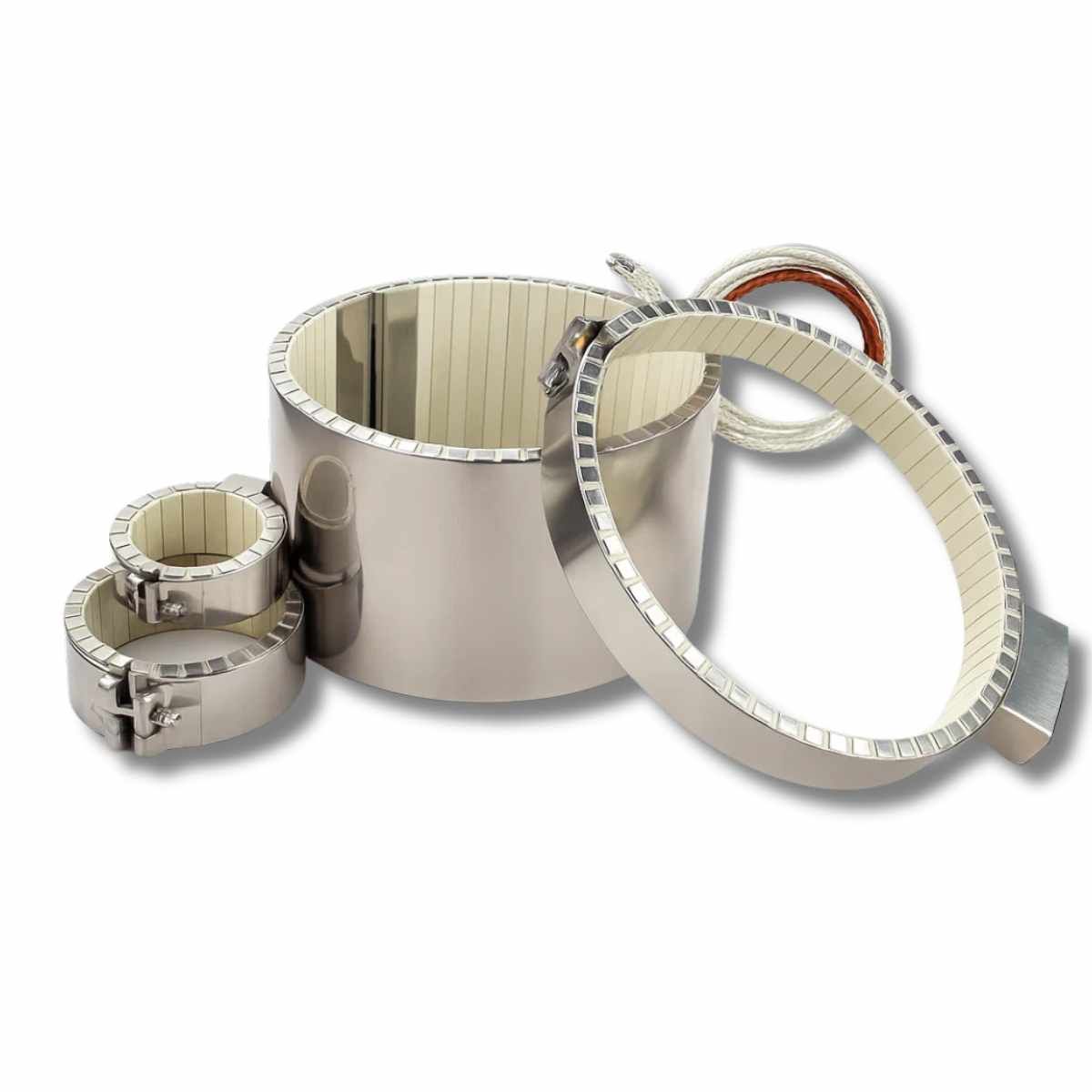
A ceramic band heater carries its resistance wire threaded through interlocking ceramic bricks, with a ceramic fibre blanket and a stainless frame behind them. We supply it for working temperatures up to 500 °C, it keeps heating even where contact with the barrel is imperfect, and its built-in insulation means less of its heat is lost to the workshop.
Nozzle Heater
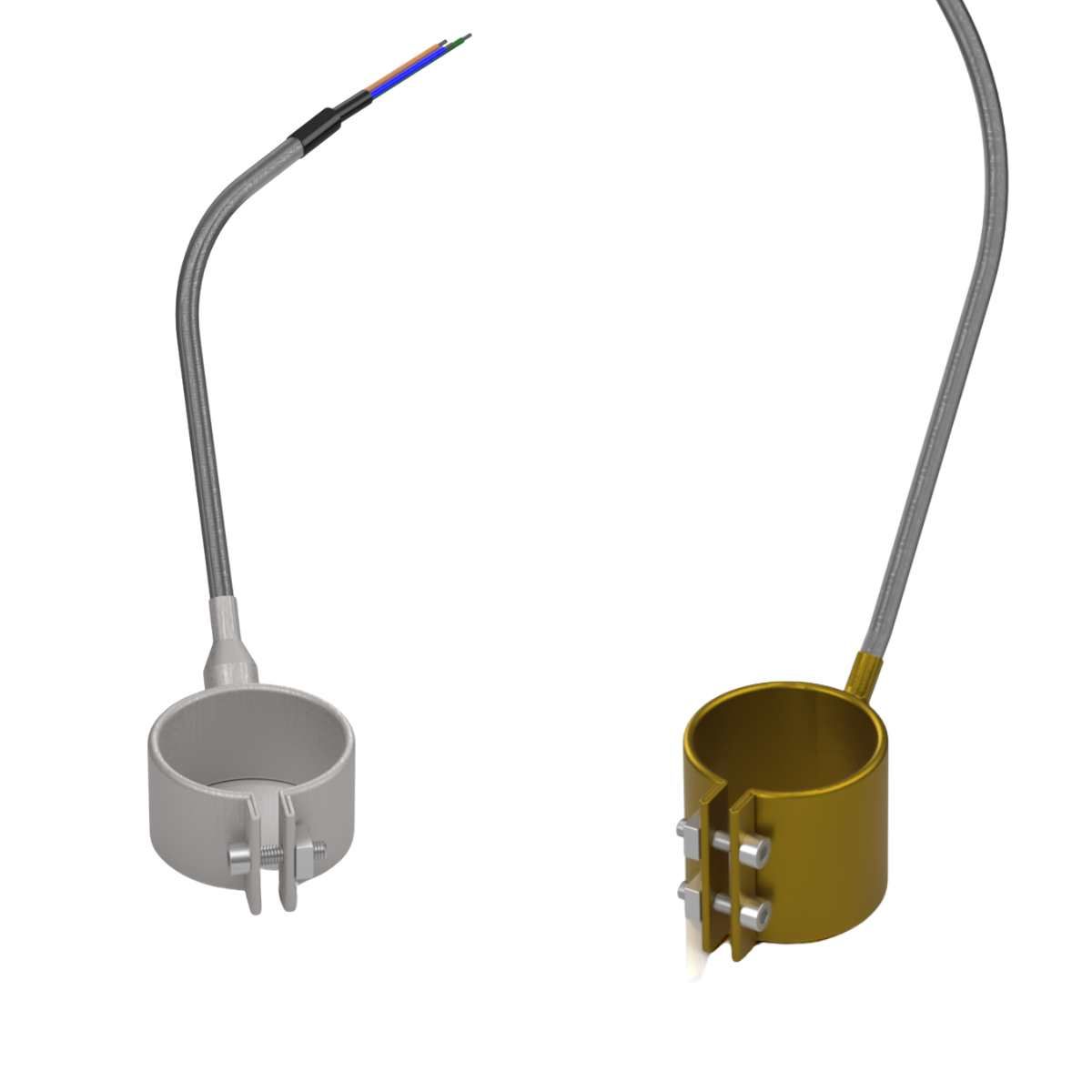
A nozzle heater is a small, narrow band heater made for the tip of an injection machine or a hot runner nozzle. It wraps a diameter of only 15 to 60 mm, often carries its own thermocouple, and holds the melt at temperature through the last few centimetres before it enters the mould.
Related Products
Mica Band Heater
A mica band heater is the thin, fast type of band heater. Flat nickel-chrome ribbon is wound over a mica sheet, covered with more mica and closed inside a stainless steel band about three millimetres thick. It heats an injection barrel quickly and cheaply, and we supply it for working temperatures up to 300 °C.
Ceramic Band Heater
A ceramic band heater carries its resistance wire threaded through interlocking ceramic bricks, with a ceramic fibre blanket and a stainless frame behind them. We supply it for working temperatures up to 500 °C, it keeps heating even where contact with the barrel is imperfect, and its built-in insulation means less of its heat is lost to the workshop.
Nozzle Heater
A nozzle heater is a small, narrow band heater made for the tip of an injection machine or a hot runner nozzle. It wraps a diameter of only 15 to 60 mm, often carries its own thermocouple, and holds the melt at temperature through the last few centimetres before it enters the mould.
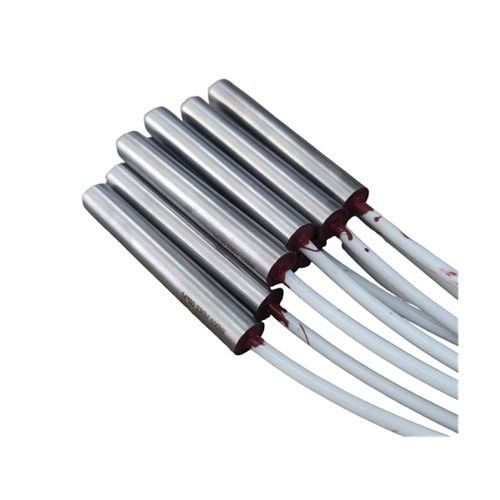
Cartridge Heater
A cartridge heater is a compact metal rod that slides into a drilled hole in a metal part and heats it from the inside. Nickel-chrome wire is wound on a ceramic core, packed with magnesium oxide and sealed in a stainless sheath. It carries far more power per square centimetre than any other element, which is why moulds, dies and platens use it.
Ask for a Price or Technical Advice
Call us or send a WhatsApp message for a price, full specifications, or a custom build.
Last updated: