Plastic Injection Molding
An injection machine heats plastic in stages: bands along the barrel, a nozzle heater at the tip, and cartridges in the hot runner and the mould. Each zone has its own element, its own sensor and its own temperature, and a weak zone shows up in the part, not on the panel.
Ask for a Price or Technical Advice
Call us or send a WhatsApp message for a price, full specifications, or a custom build.
The Job
Plastic has to be brought to melt temperature along the whole flow path and held there, zone by zone, without degrading the material or leaving a cold spot that spoils the part.
Working Conditions
The usual figures for this application. Yours may differ, and the element is sized from your figures, not these.
| Property | Value |
|---|---|
| Melt temperature, common plastics | 180 to 320 °C |
| Barrel zones | 3 to 6 per machine |
| Band heater watt density | 3 to 6 W/cm² |
| Nozzle and hot runner cartridges | 10 to 30 W/cm² |
| Mica band limit | Up to 450 °C |
| Ceramic band limit | Up to 650 °C |
| Sensor type | Type J or K thermocouple, one per zone |
What Suits It
The element types that fit this job, best first.
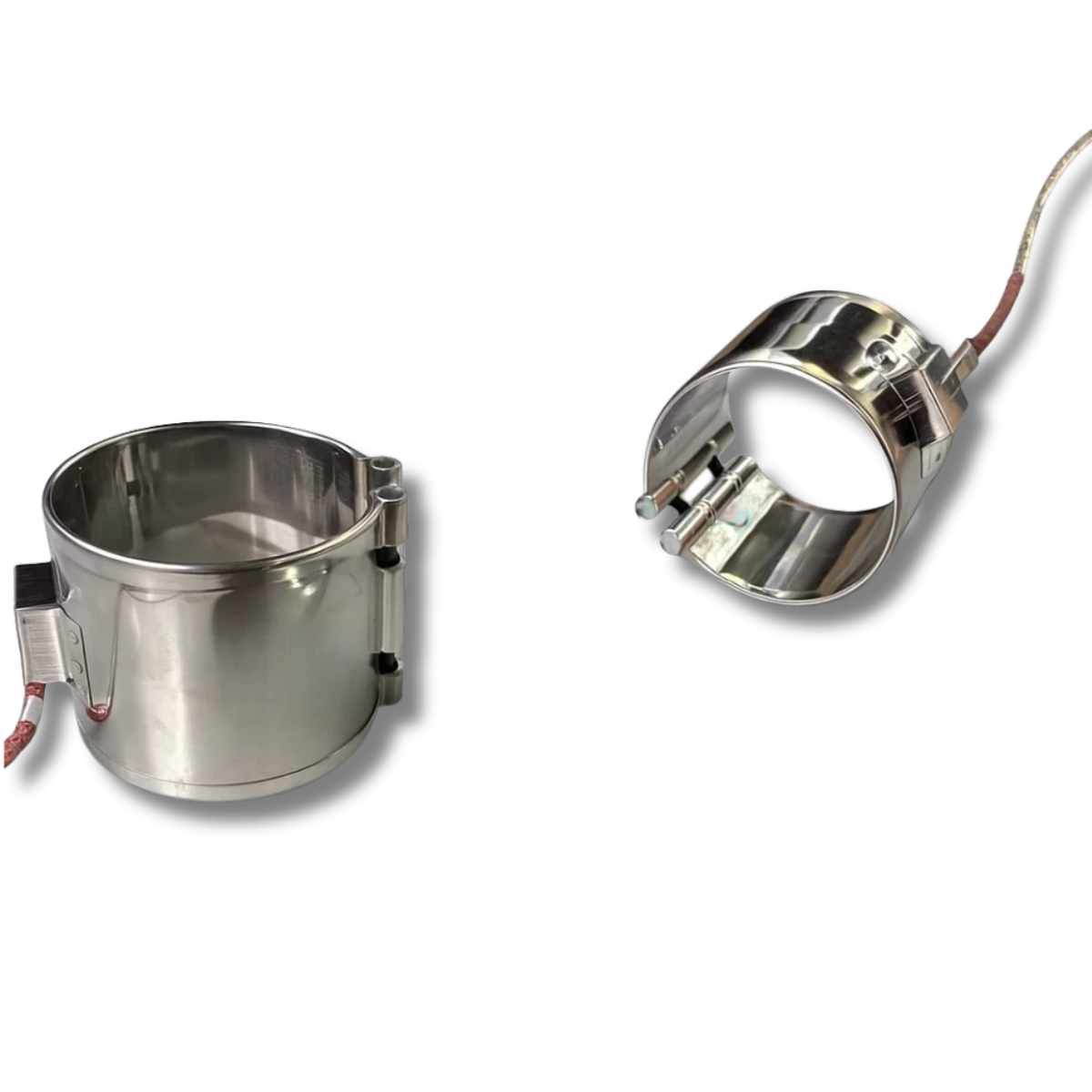
Mica Band Heater
A mica band heater is the thin, fast type of band heater. Flat nickel-chrome ribbon is wound over a mica sheet, covered with more mica and closed inside a stainless steel band about three millimetres thick. It heats an injection barrel quickly and cheaply, and we supply it for working temperatures up to 300 °C.
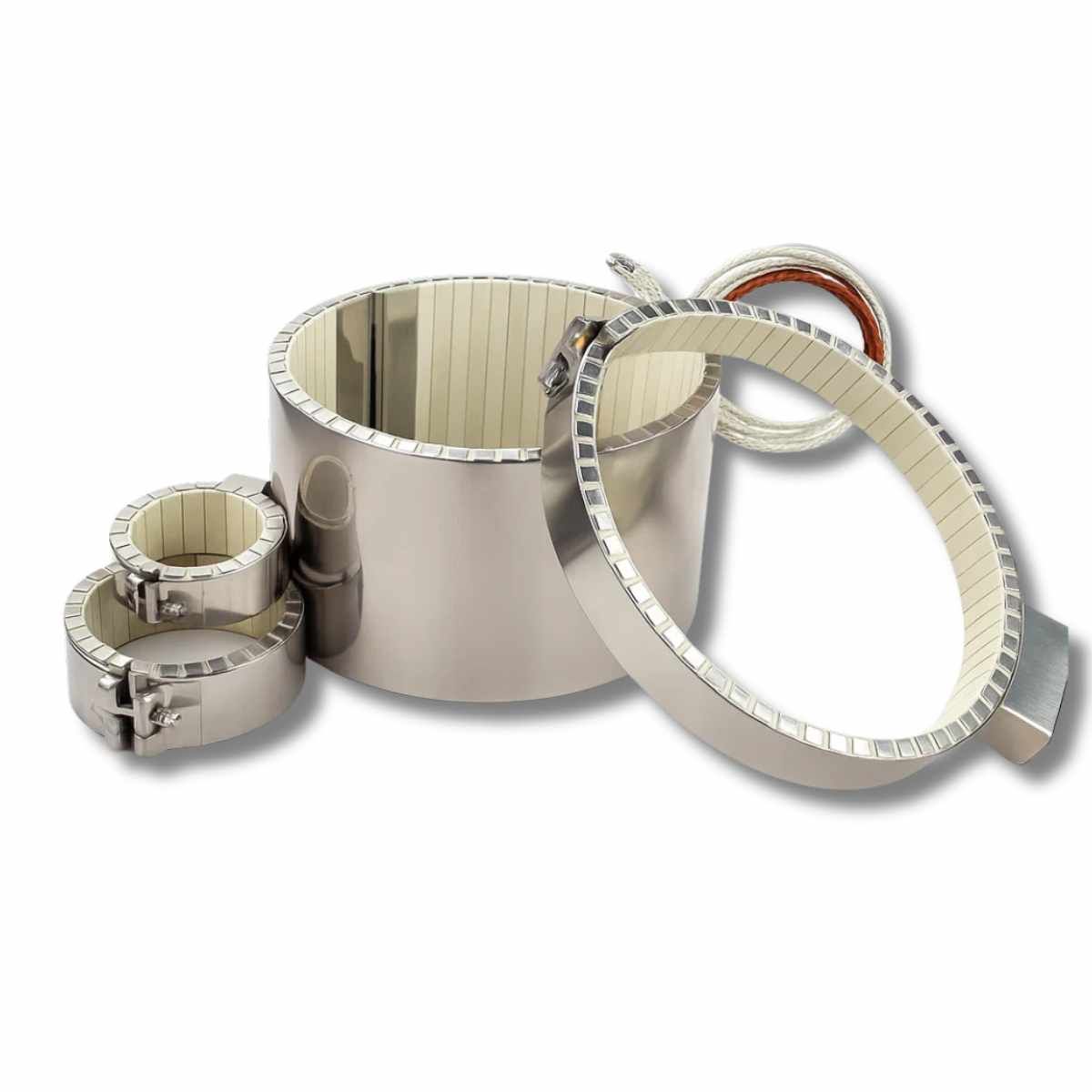
Ceramic Band Heater
A ceramic band heater carries its resistance wire threaded through interlocking ceramic bricks, with a ceramic fibre blanket and a stainless frame behind them. We supply it for working temperatures up to 500 °C, it keeps heating even where contact with the barrel is imperfect, and its built-in insulation means less of its heat is lost to the workshop.
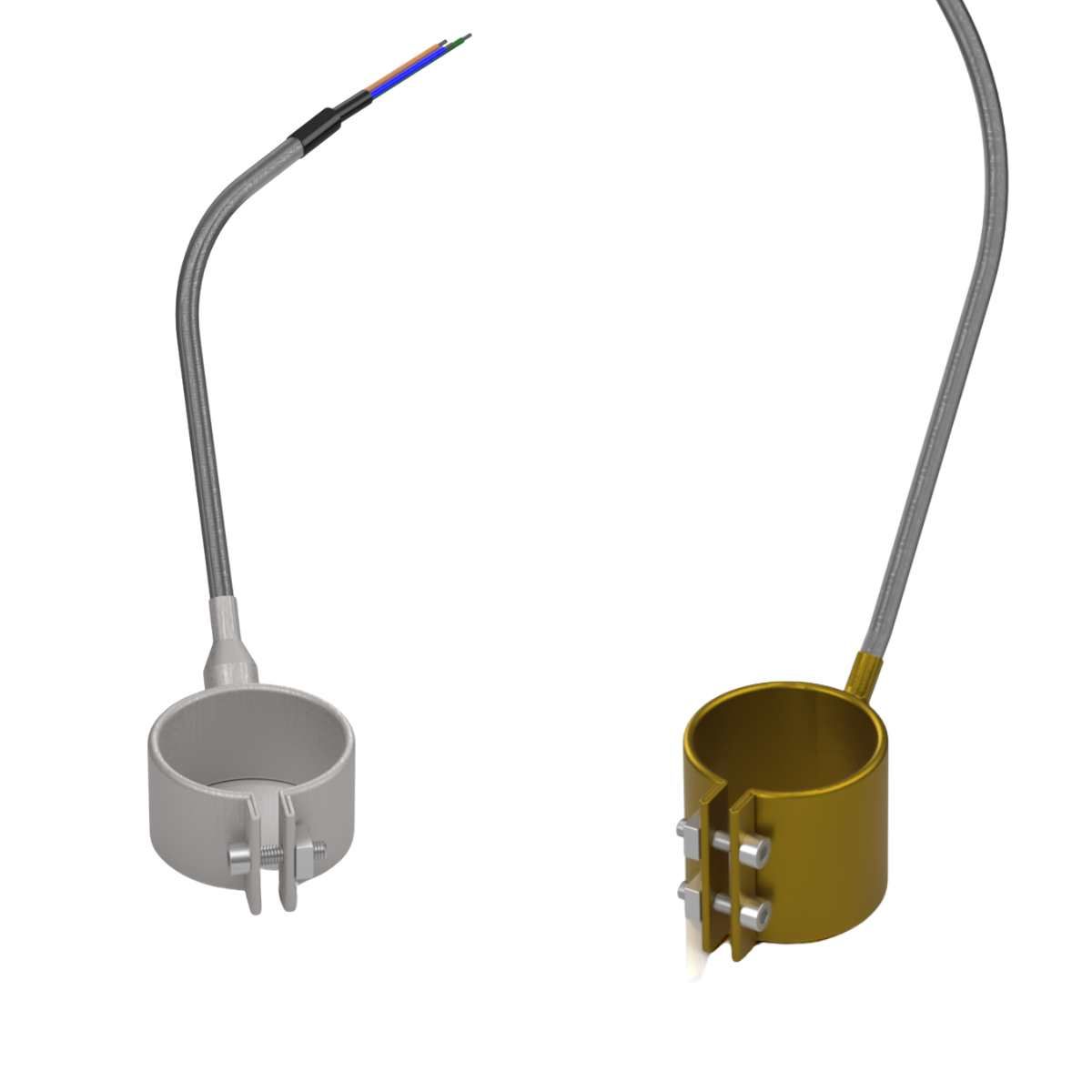
Nozzle Heater
A nozzle heater is a small, narrow band heater made for the tip of an injection machine or a hot runner nozzle. It wraps a diameter of only 15 to 60 mm, often carries its own thermocouple, and holds the melt at temperature through the last few centimetres before it enters the mould.
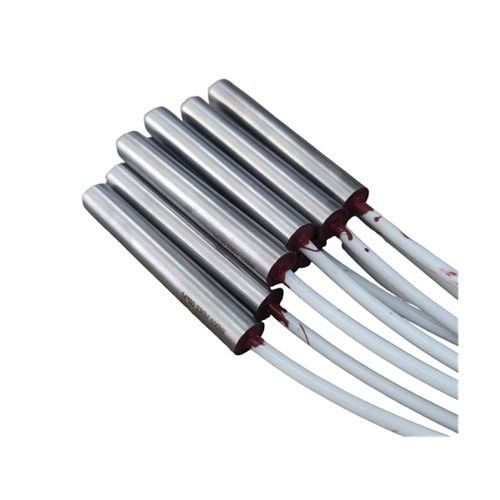
Cartridge Heater
A cartridge heater is a compact metal rod that slides into a drilled hole in a metal part and heats it from the inside. Nickel-chrome wire is wound on a ceramic core, packed with magnesium oxide and sealed in a stainless sheath. It carries far more power per square centimetre than any other element, which is why moulds, dies and platens use it.
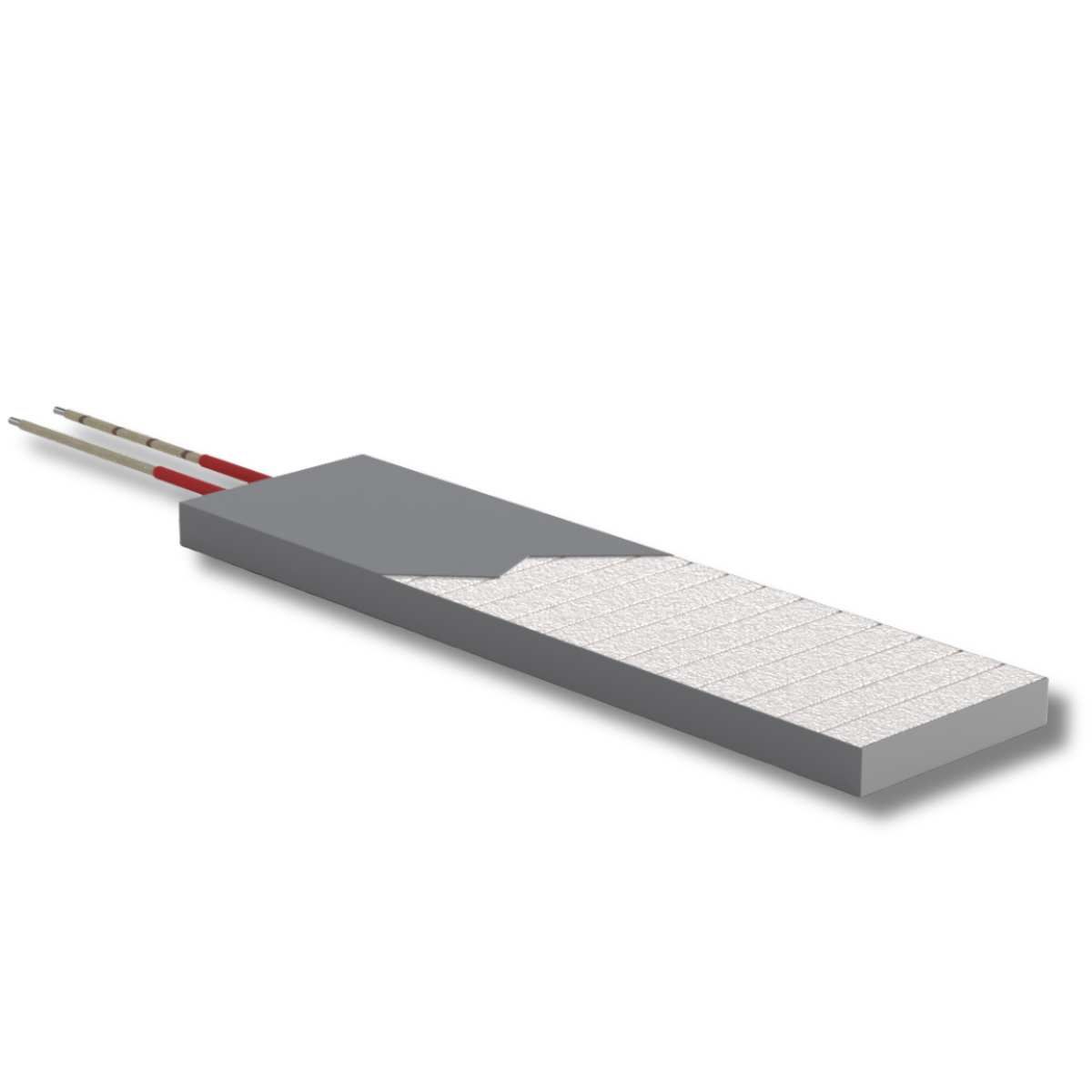
Strip Heater
A strip heater is a long, narrow flat element, usually 25 to 60 mm wide, that bolts along a bar, an edge or a plate and heats it in a line. Fitted with fins it becomes an air heater instead, and it is the simplest way to add heat to a surface that has no room for anything thicker.
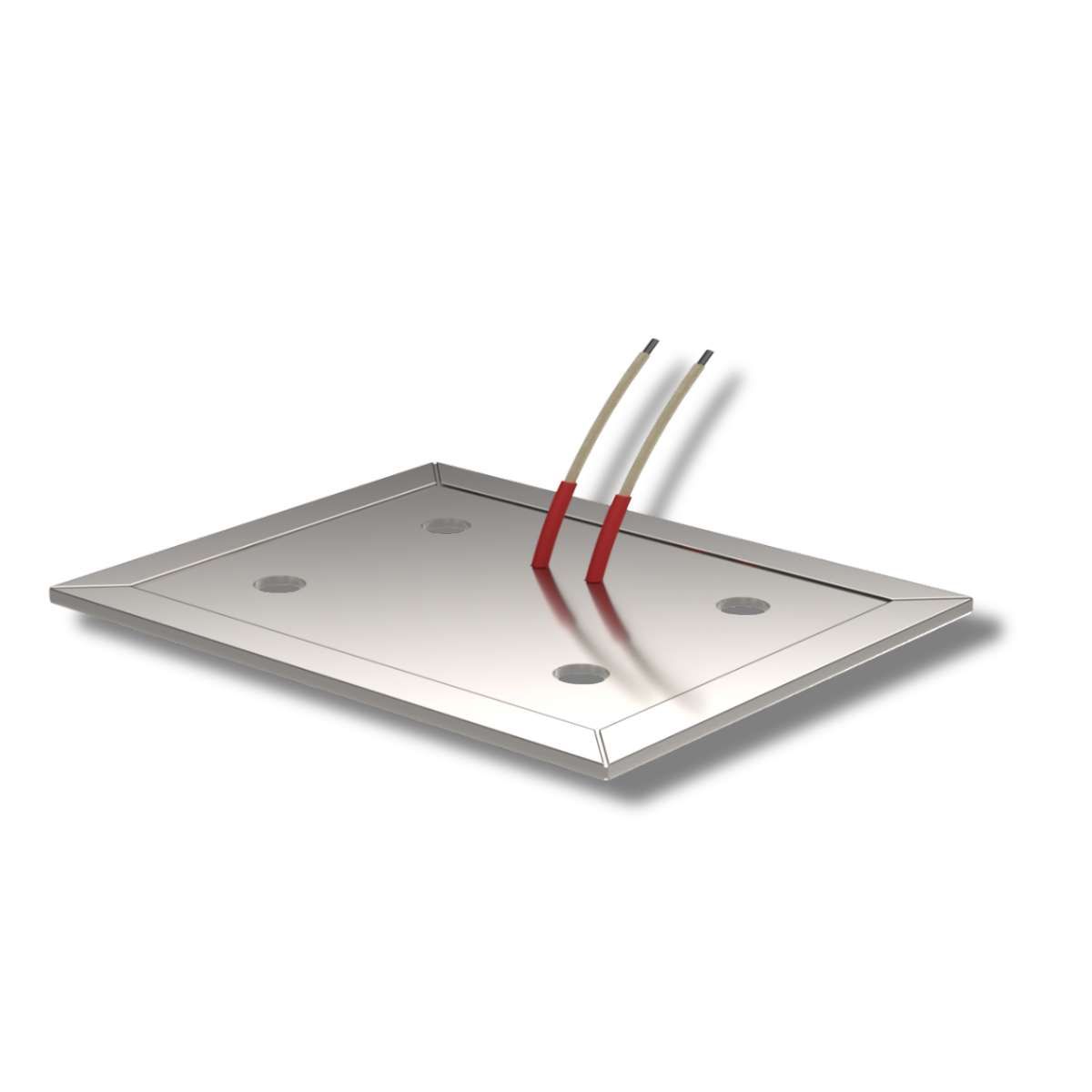
Plate Heater
A plate heater is a wide flat element that heats an area rather than a line. A resistance circuit is spread across a rectangular plate — clamped between metal sheets or cast into aluminium — so the whole face comes up to temperature together. It is used under vessels, moulds, tables and heated surfaces.
How to Get It Right
The machine is a chain of zones, not one heater
From hopper to mould, the plastic passes through the feed zone, the compression and metering zones along the barrel, the nozzle, the hot runner, and sometimes heated mould inserts. Each has its own element, its own thermocouple and its own controller channel.
That structure is why injection heating goes wrong in a specific way: one weak zone does not stop the machine. It changes the melt slightly, and the fault shows up as short shots, flow lines, burn marks or inconsistent shrinkage, which get blamed on the material or the mould long before anyone checks a heater.
A band heater is only as good as its contact
The band’s job is to conduct heat into the barrel wall. Everything that gets between the two — an air gap, a film of carbonised plastic, a distorted barrel surface — is insulation. The heat that cannot get into the barrel stays in the band, and the band runs at a temperature nobody designed for.
So a band that burns out repeatedly is usually reporting a mechanical problem. Clean the barrel surface, check the clamp, look for scoring, and only then order a replacement. Retighten new bands after the first heat cycle: the metal expands and the clamp goes slack.
Cartridge fit in a hot runner is a tolerance question
A high-watt-density cartridge in a manifold or a mould insert depends entirely on how closely the bore holds it. Within about a tenth of a millimetre it conducts well and lives a long life. Beyond that, the air gap around it does the same thing an air gap under a band does, and a cartridge with nowhere to send its heat fails from the middle outwards.
Reamed bores, clean holes and the right diameter matter more here than the element specification.
Control is only as honest as the thermocouple
Every zone is controlled to what its sensor says. A thermocouple in the wrong hole, one that has drifted, or one with a loose junction gives a controller a number that is quietly wrong, and the controller obediently holds the zone at the wrong temperature. On a material with a narrow processing window that is enough to degrade it.
When a machine starts producing marks or smells that were not there last week, check the sensors before the elements.
Soak a cold barrel before you demand full power
A barrel full of solid plastic from a shutdown must be brought up gently and held at temperature long enough for the middle to melt. Screwing it up to running temperature and starting the screw against a frozen core is how screws and barrels get damaged — and it also loads every band far harder than a warm start does.
What Usually Goes Wrong
The mistakes that shorten an element's life on this kind of job.
- Fitting a band loosely. An air gap between band and barrel is an insulator, so the band runs hot and the barrel does not.
- Replacing a burnt band without asking why it burnt. It is usually the clamping, the gap, or a failed neighbouring zone.
- Running a hot runner cartridge at high watt density in a bore that is oversized. The clearance decides its life.
- Trusting a thermocouple that has drifted or been fitted in the wrong hole, so a zone runs 30 °C off and nobody knows.
- Leaving carbonised plastic between the band and the barrel. It insulates exactly like scale in a water tank.
- Cold-starting a barrel full of solid plastic at full power instead of soaking it.
Common Questions
Mica or ceramic band — which one?
Mica up to about 450 °C, which covers most standard plastics, and it is cheaper and thinner. Ceramic up to about 650 °C and for higher watt density, better insulated and more robust, but bulkier.
Why do band heaters keep burning out on one zone?
Almost always a fitting problem rather than a heater problem. A band that is not clamped tight has an air gap, and an air gap traps the heat in the band. Check for a distorted barrel, carbon deposits under the band and a slack clamp before ordering another heater.
What watt density should a hot runner cartridge run at?
High-watt-density cartridges reach 30 W/cm² and above, but only with a close fit in the bore. Bore clearance beyond about 0.05 to 0.1 mm leaves an air gap and the cartridge cooks itself.
Do I need a thermocouple in every zone?
Yes. Each zone is controlled independently, and a shared or missing sensor means one zone is being controlled from another zone's temperature, which is how material degrades without any alarm showing.
Why is the nozzle its own zone?
The nozzle is small, loses heat to the mould it touches, and has to stay just above melt temperature. Left on the barrel's last zone it either freezes off and blocks, or overheats and drools.
Can you build a band or cartridge from the old one?
Yes. The old part, or its dimensions — diameter, width, power, voltage, lead type and hole positions — is enough to build a replacement.
Ask for a Price or Technical Advice
Call us or send a WhatsApp message for a price, full specifications, or a custom build.
Last updated: