Immersion Heater
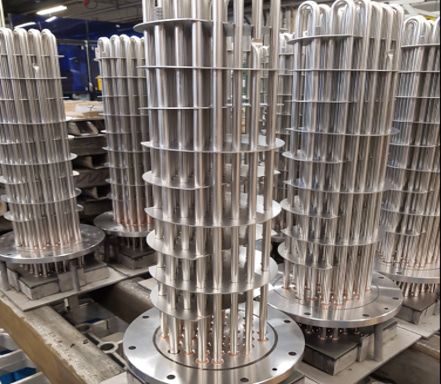
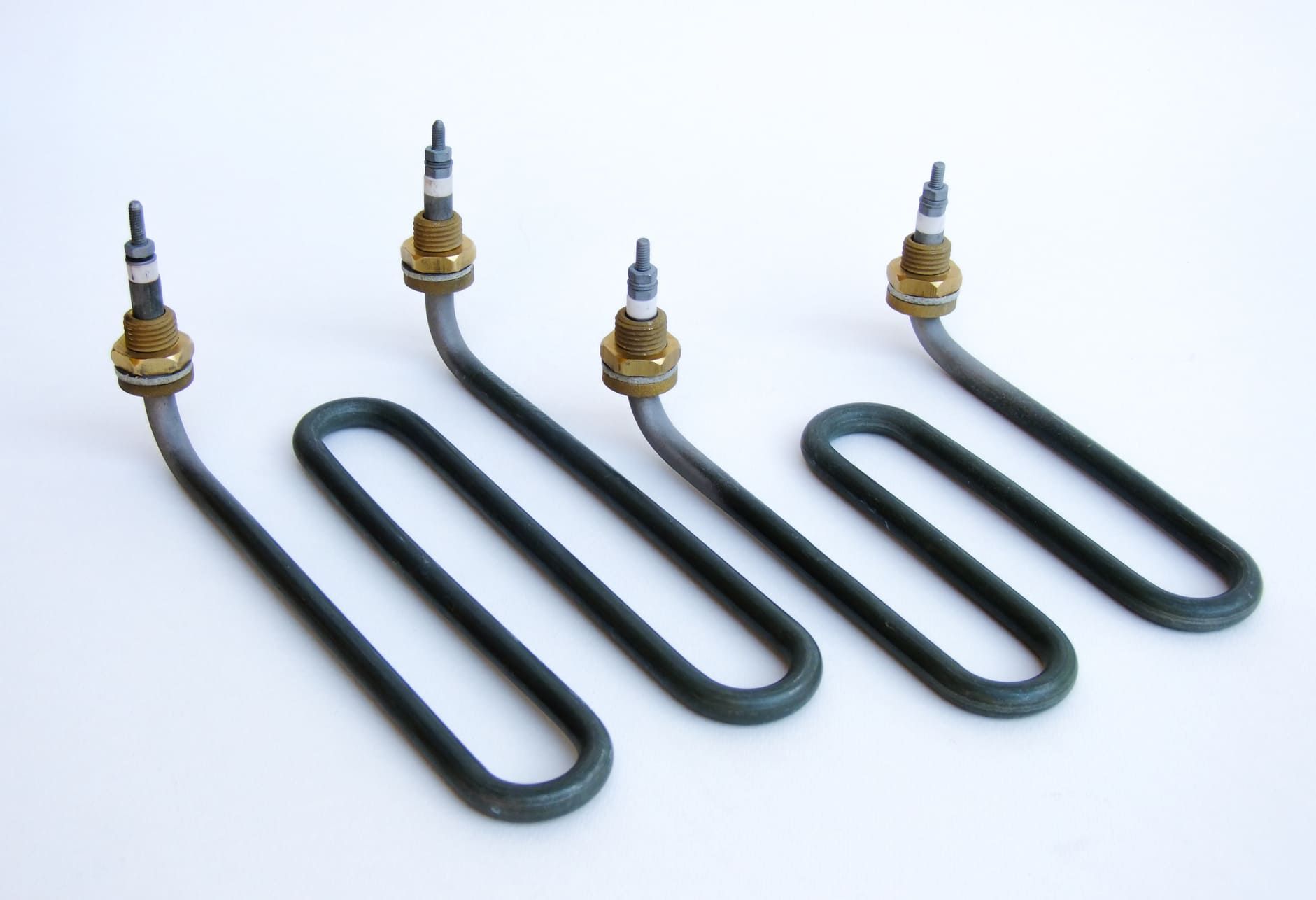
An immersion heater is a tubular element mounted on a screw plug or a flange so it can be sealed into the wall of a tank and sit directly in the liquid. It heats water, oil, fuel, chemicals and process baths from the inside, which wastes almost nothing, and it is chosen by the liquid it will live in rather than by wattage alone.
- Mounting
- Screw plug or flange
- Max sheath temperature
- up to 750 °C
- Sheath material
- Stainless, Incoloy, copper, titanium
- Watt density in water
- 8 to 12 W/cm²
- Watt density in oil
- 1 to 3 W/cm²
- Custom builds
- To drawing or sample
Ask for a Price or Technical Advice
Call us or send a WhatsApp message for a price, full specifications, or a custom build.
Technical Specifications
The figures below are the usual ranges for this type of element. Builds outside them are possible.
| Property | Value |
|---|---|
| Construction | One or more tubular elements sealed into a threaded plug or a flange, with a terminal enclosure |
| Screw plug sizes | 1, 1¼, 1½ and 2 inch BSP |
| Flange sizes | ANSI 2 to 8 inch |
| Flange material | Carbon steel, stainless, copper, Inconel, Hastelloy, titanium |
| Sheath material | Stainless 304 and 316, Incoloy 800, copper, titanium |
| Max sheath temperature | 650 (stainless) to 750 (Incoloy) °C |
| Safe watt density in water | 8 to 12 W/cm² |
| Safe watt density in oil | 1 to 3 W/cm² |
| Working voltage | 220 single phase or 380 three phase V |
| Temperature control | Thermowell with a control sensor and a separate high-limit sensor |
| Element shape | Hairpin bends, so the whole heated length stays under the liquid |
| Power tolerance | +5 to -10 % |
Where It Is Used
- Water and liquid heating
- Oil, fuel and mazut heating
- Tank and drum heating
- Food and pharmaceutical industry
- Laboratory equipment
- Plating, pickling and treatment baths
Choosing, Fitting and Looking After It
Choose by the liquid, then by the wattage
An immersion heater is defined by what it sits in. Water, thermal oil, mazut, a plating solution and a caustic wash all attack a sheath differently, and each has a different safe watt density. Getting the kilowatts right and the material wrong gives you a heater that works perfectly for four months.
Say what the liquid is when you order, including anything added to it. Chlorine in a pool, salt in a brine tank, acid in a pickling bath — those change the answer completely, and they are the details most often left out.
Keep the whole heated length under the surface
Immersion elements are bent into hairpins so a long heated length fits inside a short tank. That only helps if the bends stay submerged at the lowest working level, not the level at start-up. Work out where the surface sits when the tank is at its emptiest and mount the heater below it, with room to spare.
The cold ends should pass through the tank wall, so the hot section begins inside the liquid and the gasket never sees the hot zone.
Sludge below, foam above
In a tank that has been running a while, the bottom holds sludge and the top can hold foam or oil. Neither carries heat like the liquid does. An element resting on the floor of the tank buries itself in sediment and overheats under it. A few centimetres of clearance above the floor solves this and makes cleaning possible.
Scale is the slow killer
In hard water, limescale grows on the sheath and behaves like a blanket. A millimetre of it can push the sheath temperature up by a hundred degrees while the water gets no hotter. The first sign is not a failure — it is the tank taking longer to come up to temperature than it did last year. Descale on a schedule, and never chip scale off with a tool; that scores the sheath and starts a corrosion pit.
The terminal box is where the water gets in
Almost every earth-leakage trip on an immersion heater is a wet terminal, not a failed element. Steam rises, condenses on the inside of the enclosure and runs down onto the studs. Mount the box so its entry faces down, use a proper gland, and if the heater sits under a lid that drips, fit a cover over it.
Before recommissioning after any shutdown, measure insulation resistance to the body. A low reading means moisture has reached the magnesium oxide inside — a slow bake at low temperature often brings it back.
Gaskets are consumables
Every time a flanged heater comes out, the gasket is replaced. Re-using one is how a tank that was tight for years starts weeping down its own wall. Tighten a flange in a criss-cross pattern, in stages, and re-check the bolts once the tank has been up to temperature and back down.
Price
Price
The price for this product depends on the specification you order.
What Sets the Price
- Diameter and length
- Power and voltage needed
- Sheath material (stainless steel, brass and so on)
- Termination type and lead or thread length
- Whether a thermocouple is built in
- Order quantity
How It Compares
The two ways an immersion heater is mounted, and when each one is right.
| Feature | Screw plug | Flanged |
|---|---|---|
| Tank opening | A threaded boss, 1 to 2 inch | A bolted flange, 2 to 8 inch |
| Usual power | Up to a few kilowatts | Tens of kilowatts |
| Pressure | Low and medium | Suits pressure vessels |
| Removal | Unscrew it | Undo the bolts, replace the gasket |
| Cost | Lower | Higher, but scales to large tanks |
Common Questions
How do I pick the sheath material for my tank?
By the liquid, not by the price. Stainless 304 for ordinary water, stainless 316 for mildly corrosive solutions, Incoloy 800 for high temperatures, copper for domestic hot water, and titanium for plating baths and sea water. A sheath that is wrong for the liquid corrodes through in months.
Can an immersion heater run dry?
No. It relies on the liquid to carry heat away, and in air it burns out in minutes. Any tank whose level can drop needs a low-level switch that cuts the heater, wired so the heater cannot be energised while the level is down.
How many kilowatts do I need for my tank?
It comes from the volume of liquid, the temperature rise you want and how long you are willing to wait, plus what the tank loses through its walls. A poorly lagged tank can lose more than it takes to heat it, so insulation is usually the cheaper half of the job.
Why does the heater need two sensors?
One controls the process and sits in the liquid. The second is a high-limit sensor that cuts power if the first fails or the level drops. They are separate on purpose — a single sensor that fails takes the whole safety chain with it.
Can you make one to fit an existing tank opening?
Yes. Send the thread size or the flange drilling, the immersed depth available, the liquid, the working temperature and the power. Matching an existing opening is the normal case, not a special one.
Why is oil so much stricter than water?
Oil carries heat away far more slowly. If the sheath runs too hot the oil chars onto it, and that carbon layer acts as insulation, so the sheath gets hotter still. It is a loop that ends with a failed element and a fouled tank.
Types in This Family
Screw Plug Heater
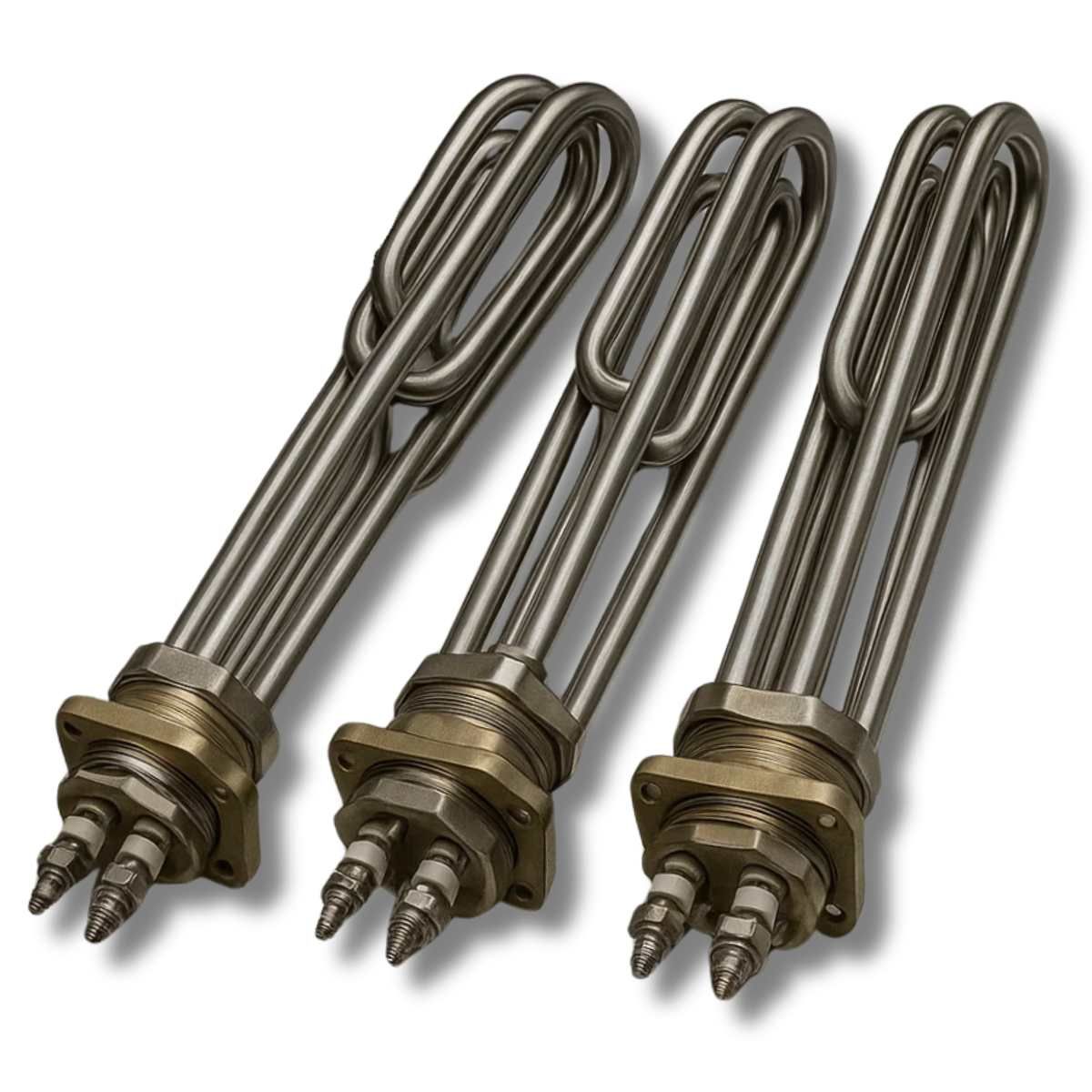
A screw plug immersion heater is a hairpin element brazed or welded into a threaded plug, so it screws straight into a boss on the side or the top of a tank. It is the simplest sealed way to put heat inside a vessel, and it suits tanks up to a few kilowatts at low and medium pressure.
Flanged Heater
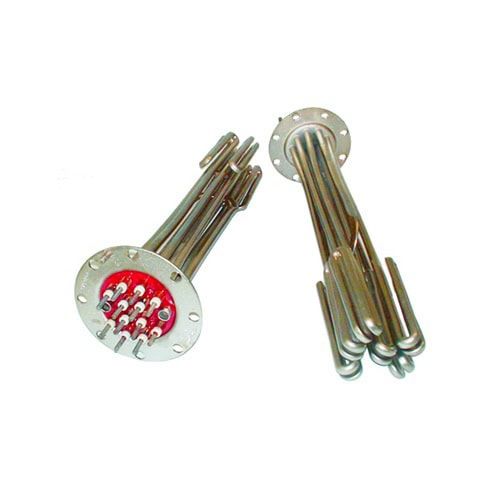
A flanged immersion heater is a bundle of hairpin elements welded into a flange that bolts onto a matching flange on the vessel. It is how large powers are put into a tank — tens of kilowatts, three phase — and it is the build used where there is pressure, a hot oil circuit, or a boiler.
Water Heater Element
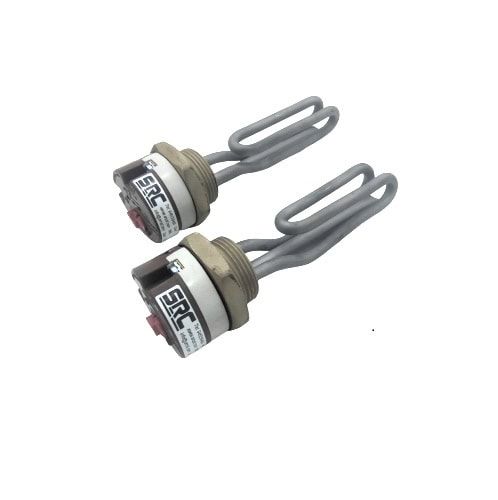
A water heater element is the screw-in element that heats a storage water heater or a hot water cylinder. It is usually a stainless steel or brass hairpin on a threaded plug, with a pocket down the middle for the thermostat, and it is chosen mainly by how hard the water is.
Samovar Element
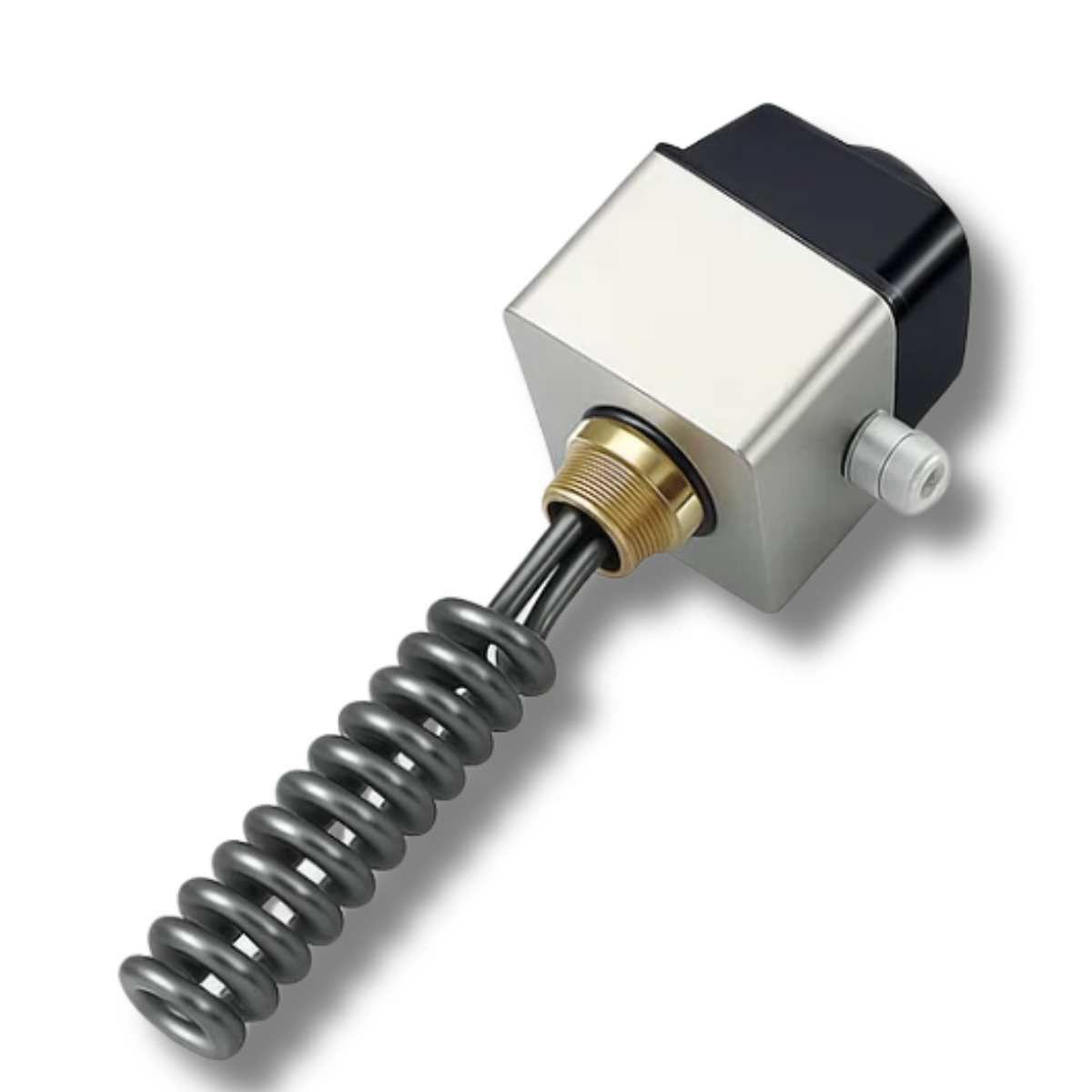
A samovar heater element is the small stainless element that sits in the water chamber of an electric samovar or a tea urn. It is usually a ring or a hairpin of 1 to 3 kW in a food-grade stainless sheath, and it spends its life in water that is boiled and refilled several times a day.
Oil and Chemical Heater
An oil and chemical immersion heater is built for liquids that punish an element: thermal oil, diesel, mazut, acids, alkalis and plating solutions. It runs at a low watt density so the sheath never gets hot enough to char the oil, and its sheath material is chosen for what the liquid does to metal.
Related Products
Screw Plug Heater
A screw plug immersion heater is a hairpin element brazed or welded into a threaded plug, so it screws straight into a boss on the side or the top of a tank. It is the simplest sealed way to put heat inside a vessel, and it suits tanks up to a few kilowatts at low and medium pressure.
Flanged Heater
A flanged immersion heater is a bundle of hairpin elements welded into a flange that bolts onto a matching flange on the vessel. It is how large powers are put into a tank — tens of kilowatts, three phase — and it is the build used where there is pressure, a hot oil circuit, or a boiler.
Water Heater Element
A water heater element is the screw-in element that heats a storage water heater or a hot water cylinder. It is usually a stainless steel or brass hairpin on a threaded plug, with a pocket down the middle for the thermostat, and it is chosen mainly by how hard the water is.
Samovar Element
A samovar heater element is the small stainless element that sits in the water chamber of an electric samovar or a tea urn. It is usually a ring or a hairpin of 1 to 3 kW in a food-grade stainless sheath, and it spends its life in water that is boiled and refilled several times a day.
Oil and Chemical Heater
An oil and chemical immersion heater is built for liquids that punish an element: thermal oil, diesel, mazut, acids, alkalis and plating solutions. It runs at a low watt density so the sheath never gets hot enough to char the oil, and its sheath material is chosen for what the liquid does to metal.
Ask for a Price or Technical Advice
Call us or send a WhatsApp message for a price, full specifications, or a custom build.
Last updated: