Radiant Heater
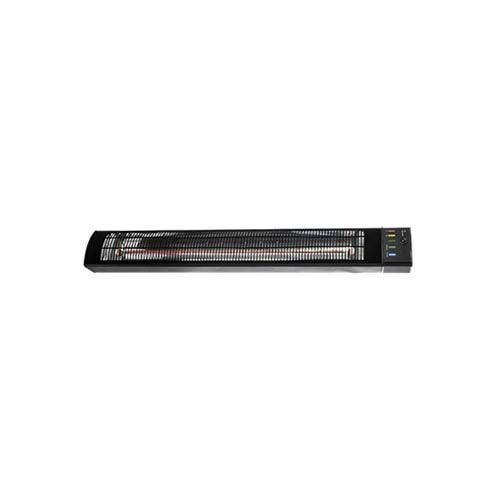
A radiant heater warms an object by infrared light rather than by touching it or by heating the air between them. A quartz tube, a halogen lamp or a ceramic face glows, and the surface facing it absorbs that energy directly. It is used where something has to be heated quickly, across a gap, without contact.
- Heating method
- Infrared, no contact needed
- Element temperature
- 300 to 2200 °C
- Response time
- Under 1 second to 10 minutes
- Types
- Quartz, halogen, ceramic
- Voltage
- 220 / 380 V
- Custom builds
- To length, power and reflector
Ask for a Price or Technical Advice
Call us or send a WhatsApp message for a price, full specifications, or a custom build.
Technical Specifications
The figures below are the usual ranges for this type of element. Builds outside them are possible.
| Property | Value |
|---|---|
| Working principle | The element radiates infrared; the object facing it absorbs the energy and heats, the air in between barely does |
| Quartz element temperature | 900 to 1200 °C |
| Halogen filament temperature | up to 2200 °C |
| Ceramic face temperature | 300 to 750 °C |
| Wavelength | Short wave (halogen), medium wave (quartz), long wave (ceramic) |
| Response time | Under 1 s (halogen), 1 to 3 s (quartz), 5 to 10 min (ceramic) |
| Reflector | Polished aluminium or gold-coated, built into the housing |
| Working voltage | 220 single phase or 380 three phase V |
| Control | Thyristor or solid state relay, not a mechanical contactor |
| Typical mounting distance | 50 to 300 mm |
| Power tolerance | +5 to -10 % |
Where It Is Used
- Air and duct heating
- Packaging machinery and shrink tunnels
- Plastic thermoforming and sheet heating
- Food and pharmaceutical industry
- Paint, powder coating and ink drying
- Preheating before welding or bonding
Choosing, Fitting and Looking After It
Match the wavelength to the material, not to the wattage
Infrared is not one thing. A short-wave halogen lamp, a medium-wave quartz tube and a long-wave ceramic panel all put out the same watts and get absorbed very differently. Metals and dark coatings take short wave well. Water, most plastics and paint films absorb medium and long wave in the top fraction of a millimetre, which is exactly where drying and forming need the heat.
Getting this wrong is not a small loss. Energy at the wrong wavelength passes through the work or bounces off it and ends up warming the machine frame.
Line of sight is the whole design
A radiant heater only heats what it can see. A shadow behind a rib, a fixture, or the edge of a tray is a cold spot, and no amount of extra power fixes it. Lay the elements out over the work the way you would lay out lights over a bench: even spacing, overlapping coverage, and nothing between the element and the surface.
At the ends of a row the coverage always falls off, because the last element only radiates onto the work from one side. Either run the elements past the edge of the work or add reflectors at the ends.
Response time changes how it is controlled
A halogen heater reaches full output in under a second and goes cold almost as fast. That is a real advantage on a line that stops and starts — nothing scorches during a pause. But it demands proper control: a solid state relay or thyristor, and a sensor fast enough to keep up. A ceramic panel is the opposite. It takes several minutes either way, so it suits a steady process and is forgiving of a slow controller, but it will happily cook whatever is under it when the line stops.
Keep the reflector clean and the housing cool
The reflector is not decoration. In most radiant assemblies close to half the output reaches the work by way of the reflector, so dust, fumes and overspray on it come straight off the heating rate. Clean it on the same schedule as the rest of the machine.
The housing behind the reflector needs air moving over it, especially on halogen. Sealed into a box with no ventilation, the terminals and lead seals run far above what they were designed for, and they fail before the element does.
Ventilation is a process variable, not a comfort issue
If the process gives off water vapour or solvent, that vapour absorbs infrared before it reaches the work and it drifts. Extraction over a radiant drying tunnel is not only there for the operator; it keeps the heating consistent from the first part of the shift to the last.
Mounting and orientation
Halogen lamps have a preferred mounting position, usually horizontal, and life drops sharply if that is ignored. Quartz tubes need room to expand along their length — clamped rigidly at both ends they crack at the first heat cycle. Leave the fixings free to slide and support long tubes at the middle.
Price
Price
The price for this product depends on the specification you order.
What Sets the Price
- Diameter and length
- Power and voltage needed
- Sheath material (stainless steel, brass and so on)
- Termination type and lead or thread length
- Whether a thermocouple is built in
- Order quantity
How It Compares
The three radiant types, and what each is good at.
| Feature | Halogen | Quartz | Ceramic |
|---|---|---|---|
| Wavelength | Short | Medium | Long |
| Response | Under a second | A second or two | Several minutes |
| Best on | Metals and dark surfaces | General purpose drying | Plastics and even, gentle heat |
| Visible glow | Bright white | Orange | Almost none |
Common Questions
How is a radiant heater different from a normal one?
A normal element heats the air, and the air heats the object. A radiant heater sends energy straight to the surface facing it, so the object gets hot while the air around it stays comparatively cool. In a draughty workshop or an open line, that is the difference between working and not.
Which type do I need for plastic?
Usually medium or long wave — quartz or ceramic. Most plastics absorb those wavelengths in their surface, which is what you want for forming or shrinking. Short wave halogen passes deeper into some plastics and can overheat the inside while the surface still looks right.
How far away should it be mounted?
Close enough that most of what it radiates lands on the work, usually between 50 and 300 mm. Twice the distance is roughly a quarter of the intensity. Too close gives a burnt stripe under each element; too far heats the room.
Can I switch it with an ordinary contactor?
Not for long. A halogen or quartz heater is switched on and off constantly by the controller, and a mechanical contactor wears out in weeks. Use a solid state relay or a thyristor, which also lets the power be varied instead of just switched.
Why does the reflector matter so much?
Because half the infrared leaves the element pointing the wrong way. A clean, polished reflector turns that half back onto the work. A reflector that has gone dull with dust and fumes can cost a third of the heater's useful output, and it is rarely the first thing anyone checks.
Why should quartz tubes not be handled with bare hands?
Skin leaves salt and oil on the quartz. At working temperature that mark changes the structure of the glass at that spot, and the tube fails there. Fit them with clean gloves, and wipe any fingerprints off with alcohol before the first run.
Types in This Family
Quartz Heater
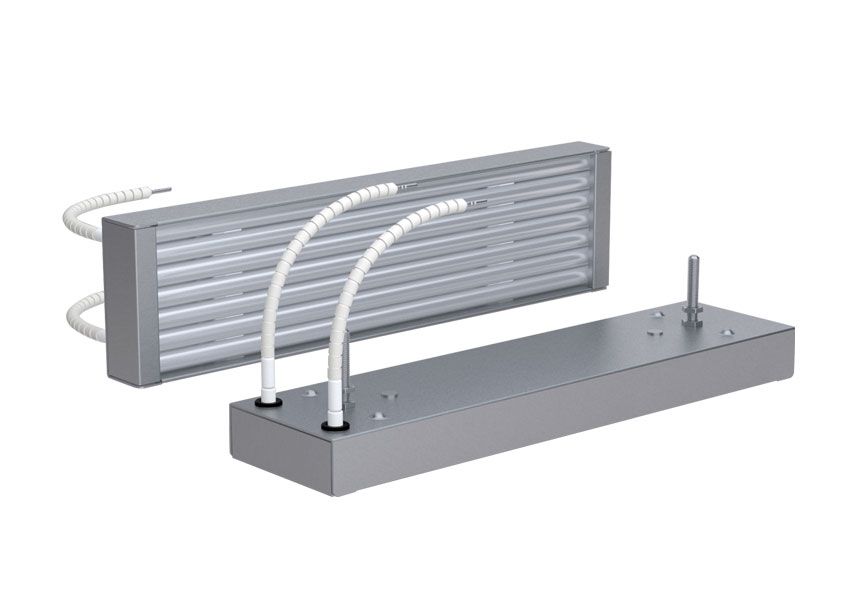
A quartz heater is a coiled resistance wire inside a clear quartz tube. The tube reaches 900 to 1200 °C and radiates medium-wave infrared, which most plastics, coatings and water absorb well. It reaches working output in a second or two and is the general-purpose radiant element for drying and forming.
Halogen Heater
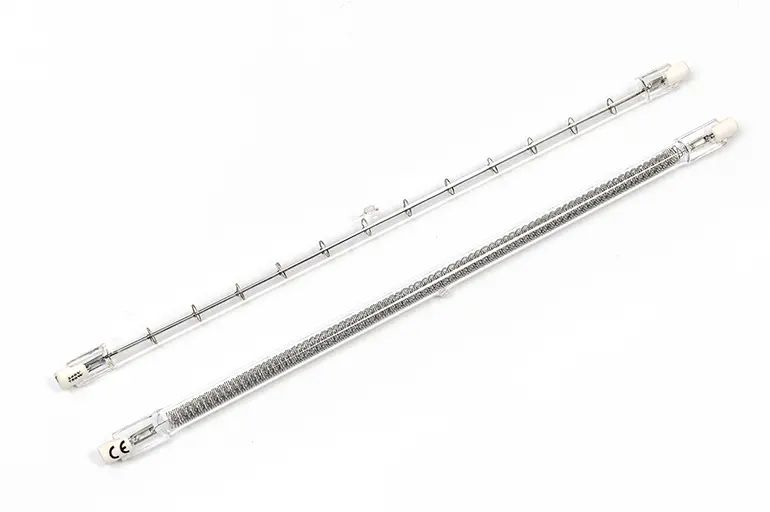
A halogen heater is a tungsten filament in a halogen-filled quartz lamp, running at up to 2200 °C. It emits short-wave infrared, reaches full output in under a second, and goes cold almost as fast. It is chosen where heat has to be intense, local, and switched on and off with the process.
Ceramic Infrared Heater
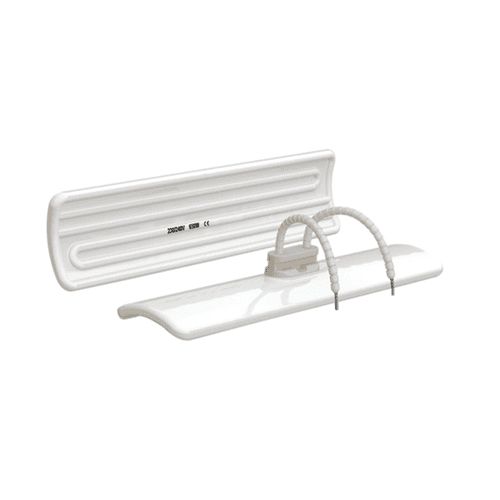
A ceramic infrared heater is a resistance coil embedded in a glazed ceramic body that radiates long-wave infrared from a face running at 300 to 750 °C. It is slow, steady and robust, and it is the radiant element used where plastic has to be heated evenly without being scorched.
Related Products
Quartz Heater
A quartz heater is a coiled resistance wire inside a clear quartz tube. The tube reaches 900 to 1200 °C and radiates medium-wave infrared, which most plastics, coatings and water absorb well. It reaches working output in a second or two and is the general-purpose radiant element for drying and forming.
Halogen Heater
A halogen heater is a tungsten filament in a halogen-filled quartz lamp, running at up to 2200 °C. It emits short-wave infrared, reaches full output in under a second, and goes cold almost as fast. It is chosen where heat has to be intense, local, and switched on and off with the process.
Ceramic Infrared Heater
A ceramic infrared heater is a resistance coil embedded in a glazed ceramic body that radiates long-wave infrared from a face running at 300 to 750 °C. It is slow, steady and robust, and it is the radiant element used where plastic has to be heated evenly without being scorched.
Ask for a Price or Technical Advice
Call us or send a WhatsApp message for a price, full specifications, or a custom build.
Last updated: