Flat and Strip Heater
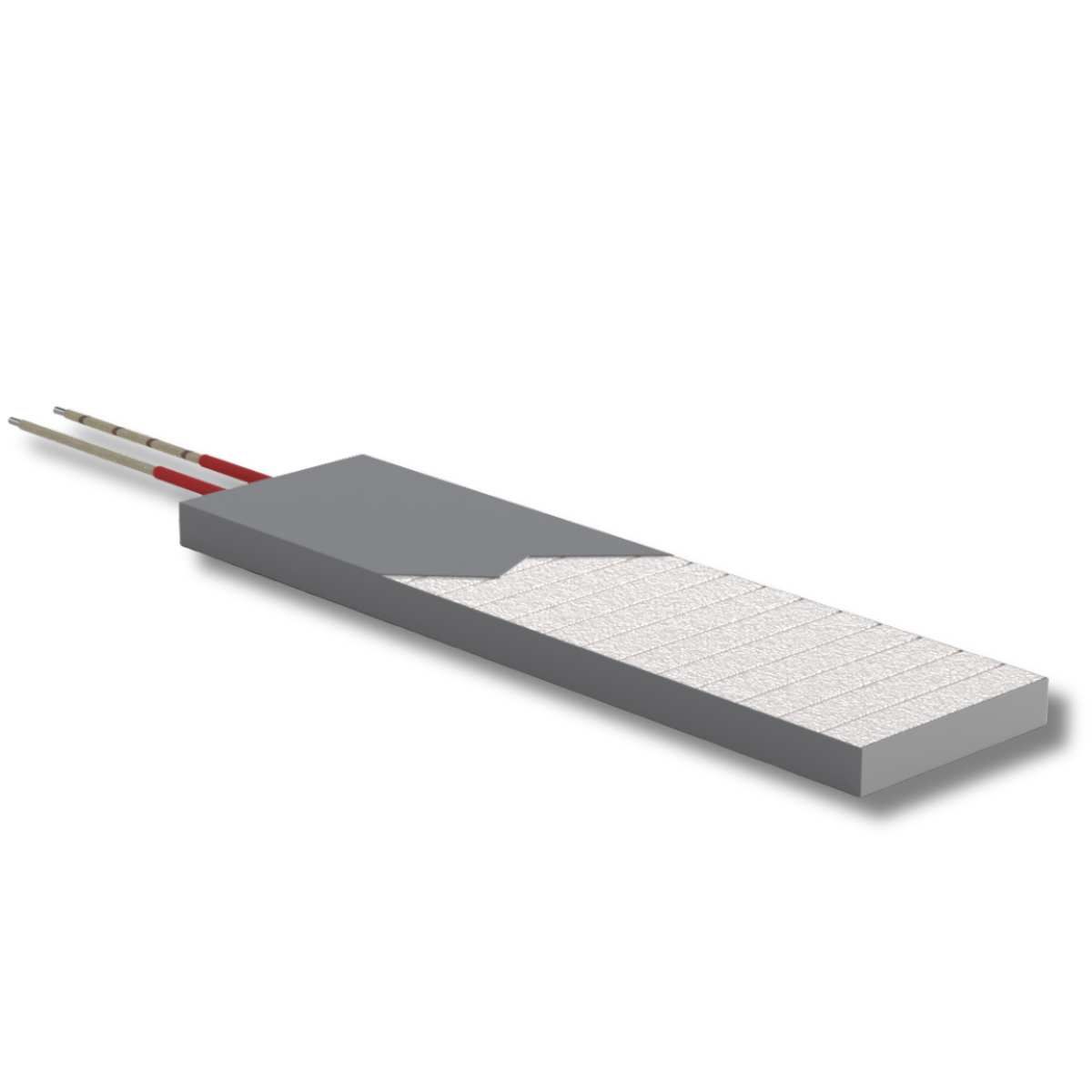
A flat or strip heater is a rectangular element that bolts against a flat surface and heats it by contact. Resistance wire sits on mica or in compacted magnesium oxide inside a steel or stainless case. It is the element used wherever the thing being heated is a plate, a bar or a platen rather than a liquid or a pipe.
- Max sheath temperature
- 450 (mica) to 600 (ceramic) °C
- Common widths
- 25 to 60 mm
- Watt density on metal
- 2 to 5 W/cm²
- Case material
- Stainless or aluminised steel
- Voltage
- 220 / 380 V
- Custom builds
- Any length and fixing centres
Ask for a Price or Technical Advice
Call us or send a WhatsApp message for a price, full specifications, or a custom build.
Technical Specifications
The figures below are the usual ranges for this type of element. Builds outside them are possible.
| Property | Value |
|---|---|
| Construction | Resistance wire on a mica sheet or in magnesium oxide, pressed inside a metal case |
| Case material | Stainless 304, aluminised steel, stainless 321 |
| Max sheath temperature | 450 (mica insulated) to 600 (ceramic insulated) °C |
| Width | 25, 30, 38, 50, 60 mm |
| Thickness | 8 to 12 mm |
| Length (general industry range) | 100 to 1500 mm |
| Safe watt density clamped to metal | 2 to 5 W/cm² |
| Safe watt density radiating into air | 1 to 2 W/cm² |
| Working voltage | 220 single phase or 380 three phase V |
| Fixing | Slotted holes at the ends, or threaded studs on the back |
| Termination | Threaded studs under a cover, or nickel leads with ceramic beads |
| Power tolerance | +5 to -10 % |
Where It Is Used
- Packaging and sealing machinery
- Plastic injection and extrusion tooling
- Air and duct heating
- Laboratory equipment
- Heated platens and press plates
- Frost protection on panels and cabinets
Choosing, Fitting and Looking After It
Contact is everything, and contact means flat
A flat heater sends its heat into whatever it is touching. Where it is not touching, that heat has nowhere to go. A plate that is bowed by half a millimetre leaves an air gap in the middle, and that is exactly where the element will fail — not at the ends, in the middle, where nothing was carrying the heat away.
Before fitting, put a straight edge across the surface. If it rocks, machine or lap it flat. It is cheaper than a heater every six months.
Tighten from the middle, and leave the ends free to move
Flat heaters are fixed through slotted holes rather than round ones for a reason. The heater grows several tenths of a millimetre as it comes up to temperature, and if both ends are pinned it has to buckle somewhere. Bolt the centre firmly, let the end slots take the movement, and use spring washers so the clamping force survives the first few heat cycles.
Overtightening is its own failure. The case is thin, and a bolt pulled down hard dents it into the mica underneath, which is where an earth fault starts.
Watt density falls the moment it is not touching metal
The same heater has two completely different ratings. Clamped to a steel plate it can run at 2 to 5 watts per square centimetre. Standing in open air, radiating, it must come down to around 1 to 2 or its own insulation cooks. This catches people out when a heater is bought for a platen and later re-used inside a duct.
Heat spreads along the metal, not evenly out of the heater
A strip heater is a line of heat. The plate it is bolted to does the spreading, and thin plate spreads badly. If a wide surface has to be even in temperature, either use a wider plate heater or use two strips spaced apart, rather than one strip with double the power. Doubling the power of a single strip makes the strip hotter, not the plate more even.
Keep the terminals out of the heat and out of the way
The terminal end has no heat of its own but sits next to something that does. Route leads away from the hot surface, use ceramic beads or a nickel lead where they cannot be routed away, and fit the terminal cover — an exposed stud on a machine that vibrates eventually finds something to short against.
Reading a heater that has already failed
Before ordering a replacement, measure the old one. Resistance across the terminals tells you the wattage it really was, which is often not the wattage written on the machine. Resistance from a terminal to the case tells you whether it failed open or failed to earth. A heater that failed to earth usually points at a mechanical cause — a dent, a trapped lead, or moisture — and that cause is still there waiting for the new one.
Price
Price
The price for this product depends on the specification you order.
What Sets the Price
- Diameter and length
- Power and voltage needed
- Sheath material (stainless steel, brass and so on)
- Termination type and lead or thread length
- Whether a thermocouple is built in
- Order quantity
How It Compares
What separates the three shapes in this family.
| Feature | Strip | Plate | Press |
|---|---|---|---|
| Shape | Long and narrow | Wide rectangle | Sized to the press bed |
| Usual job | Heating a bar or an edge | Heating a whole surface | Even heat across a platen |
| Mounting | Bolted through end slots | Bolted or clamped flat | Built into the platen |
| Heat spread | A line of heat | An area of heat | Evened out across the plate |
Common Questions
What is the difference between a strip heater and a band heater?
They are built almost the same way; the difference is what they wrap. A strip heater is flat and stays flat against a plate or a bar. A band heater is rolled into a ring and clamps around a cylinder. A flat heater bent around a barrel will not make proper contact.
Can a strip heater be used to heat air?
Yes, but at a much lower watt density. Bolted to metal it can carry 2 to 5 watts per square centimetre; radiating into open air it must be derated to about 1 to 2, or it will run hot enough to damage its own insulation.
Does the surface need machining first?
It needs to be flat and clean, which usually means flat within a few tenths of a millimetre across the length of the heater. Paint, scale and old gasket material all act as insulation, and an air gap under a flat heater is the most common reason one burns out.
What length can be made?
Length is made to order — the heater is built for your fixing centres, not cut from a standard bar. Send the overall length, the width, the distance between the mounting holes and the wattage, and the element is built around them.
Mica or ceramic insulation — which do I need?
Mica up to about 450 °C, which covers most sealing and packaging work. Ceramic, meaning magnesium oxide, above that and up to about 600 °C. Mica is thinner and responds faster; ceramic takes more heat and lasts longer under it.
Can you copy an old heater that has no markings?
Yes. Measure the length, width, thickness, the hole positions and the voltage on the machine plate, and send a photograph of how the leads come out. Wattage can be worked back from the resistance of the old element if it is not burnt open.
Types in This Family
Strip Heater
A strip heater is a long, narrow flat element, usually 25 to 60 mm wide, that bolts along a bar, an edge or a plate and heats it in a line. Fitted with fins it becomes an air heater instead, and it is the simplest way to add heat to a surface that has no room for anything thicker.
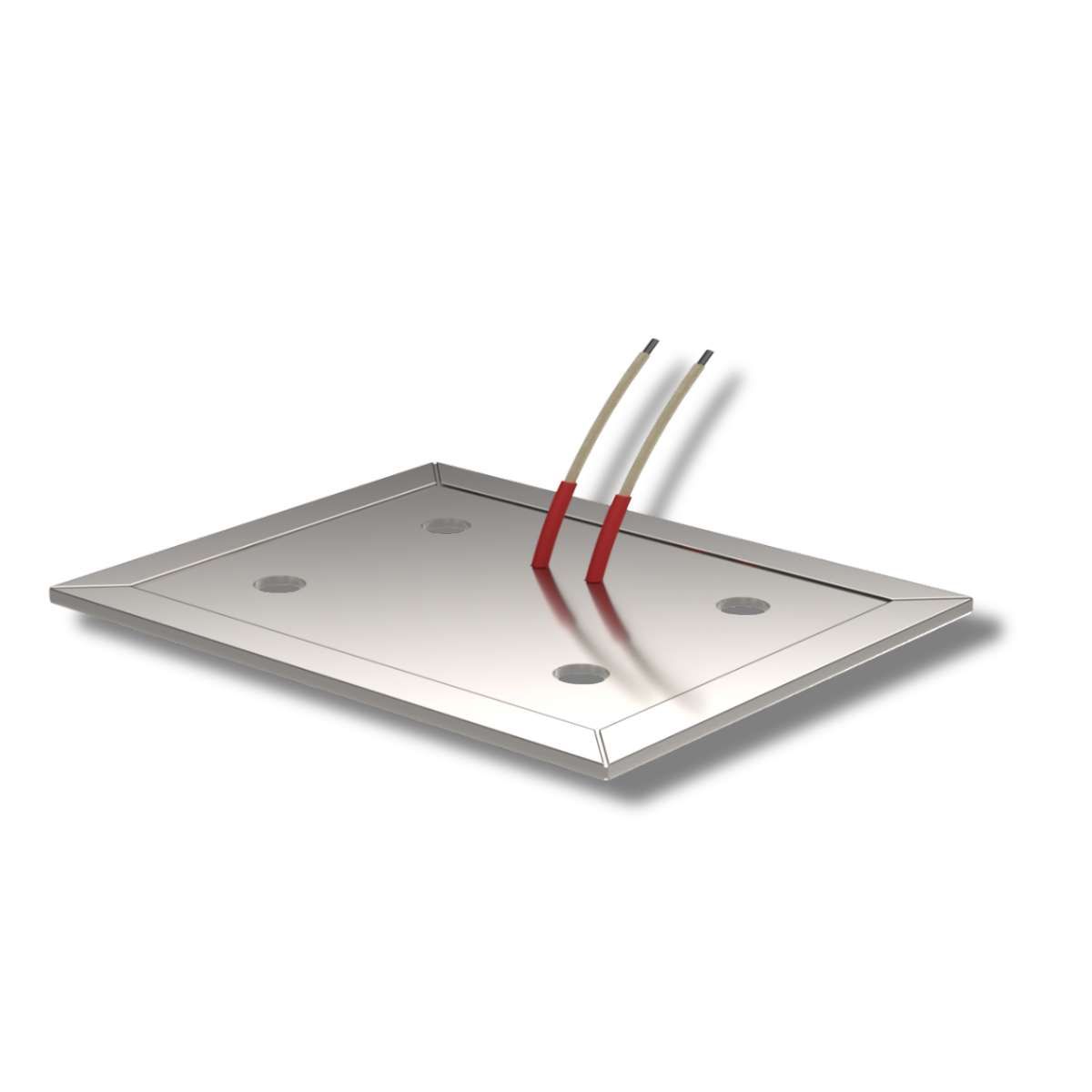
Plate Heater
A plate heater is a wide flat element that heats an area rather than a line. A resistance circuit is spread across a rectangular plate — clamped between metal sheets or cast into aluminium — so the whole face comes up to temperature together. It is used under vessels, moulds, tables and heated surfaces.
Heat Press Heater
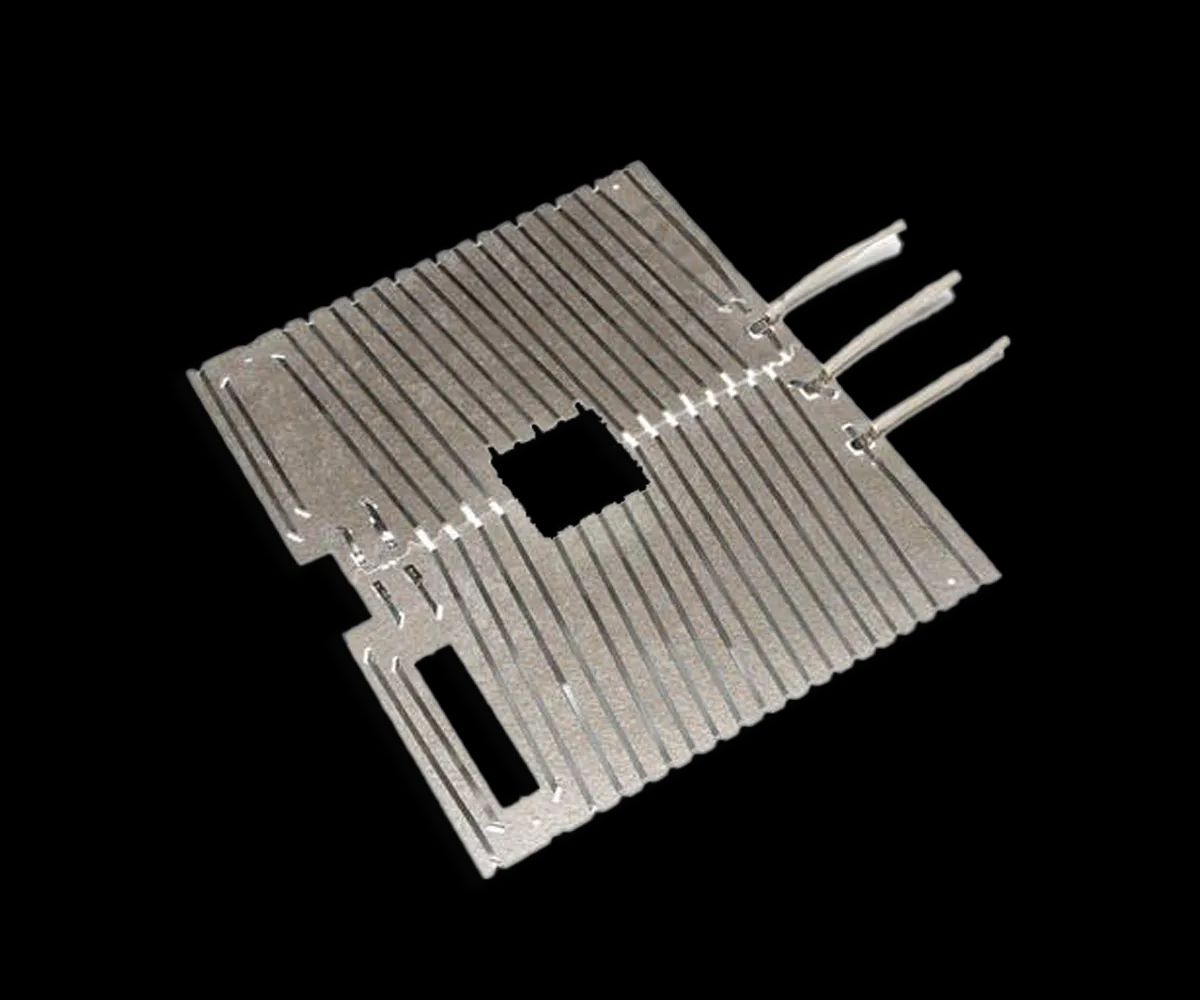
A heat press heater is the element built into the platen of a press — a heat transfer press, a laminating press, a hot stamping or a vulcanising machine. Its whole job is an even temperature across the pressing face, because everything the press makes is only as good as the coldest corner of that face.
Related Products
Strip Heater
A strip heater is a long, narrow flat element, usually 25 to 60 mm wide, that bolts along a bar, an edge or a plate and heats it in a line. Fitted with fins it becomes an air heater instead, and it is the simplest way to add heat to a surface that has no room for anything thicker.
Plate Heater
A plate heater is a wide flat element that heats an area rather than a line. A resistance circuit is spread across a rectangular plate — clamped between metal sheets or cast into aluminium — so the whole face comes up to temperature together. It is used under vessels, moulds, tables and heated surfaces.
Heat Press Heater
A heat press heater is the element built into the platen of a press — a heat transfer press, a laminating press, a hot stamping or a vulcanising machine. Its whole job is an even temperature across the pressing face, because everything the press makes is only as good as the coldest corner of that face.
Ask for a Price or Technical Advice
Call us or send a WhatsApp message for a price, full specifications, or a custom build.
Last updated: