Strip Heater
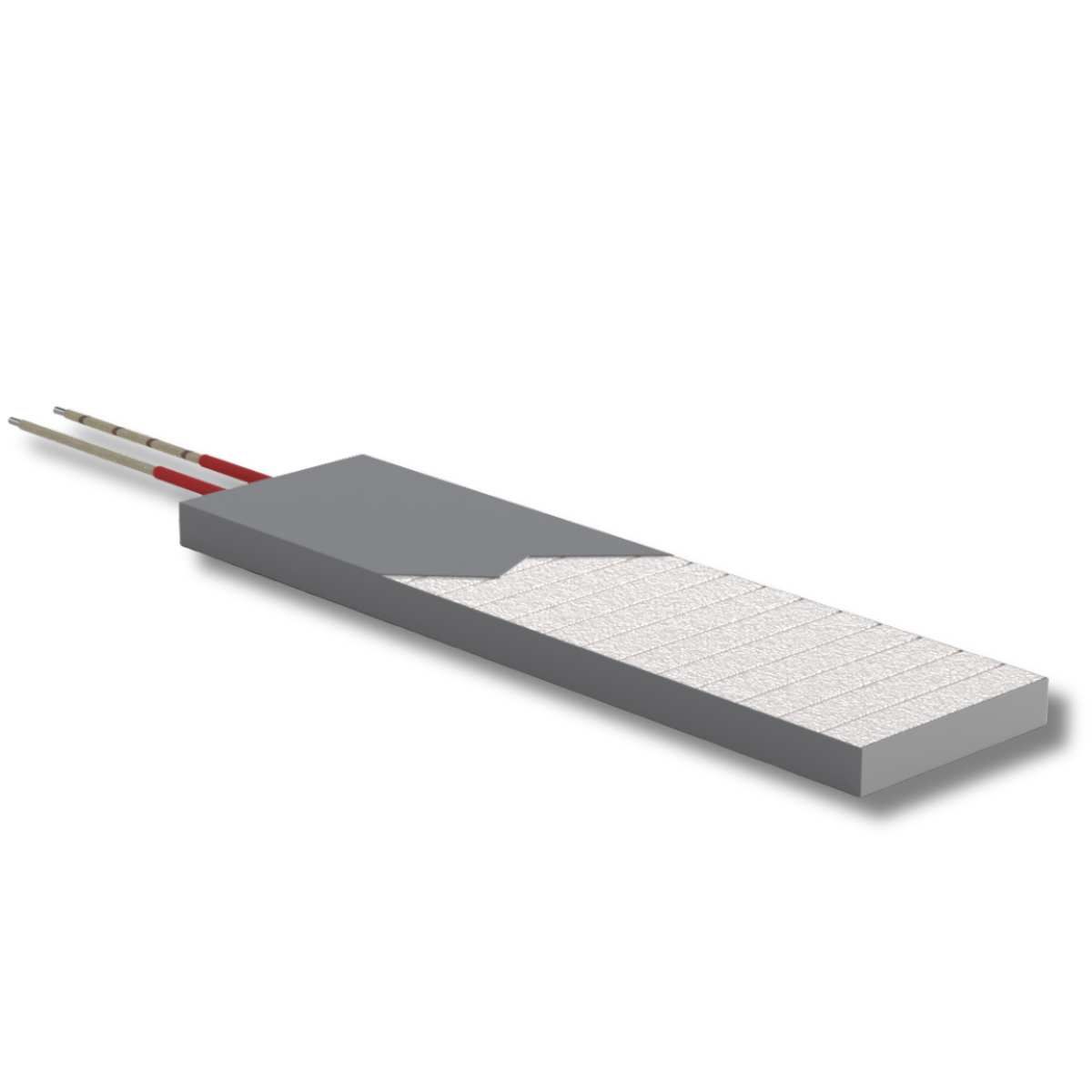
A strip heater is a long, narrow flat element, usually 25 to 60 mm wide, that bolts along a bar, an edge or a plate and heats it in a line. Fitted with fins it becomes an air heater instead, and it is the simplest way to add heat to a surface that has no room for anything thicker.
- Width
- 30 to 100 mm
- Max temperature
- up to 200 °C
- Watt density on metal
- 2 to 5 W/cm²
- Finned version
- For heating air
- Voltage
- 220 V
- Custom builds
- Any length and hole centres
Ask for a Price or Technical Advice
Call us or send a WhatsApp message for a price, full specifications, or a custom build.
Technical Specifications
The figures below are the usual ranges for this type of element. Builds outside them are possible.
| Property | Value |
|---|---|
| Construction | Resistance wire on mica or in magnesium oxide, pressed inside a narrow metal case |
| Case material | Stainless 304, stainless 321, aluminised steel |
| Max working temperature | up to 200 °C |
| Width | 30 to 100 mm |
| Thickness | 8 to 12 mm |
| Length | 300 to 1000 mm |
| Safe watt density bolted to metal | 2 to 5 W/cm² |
| Safe watt density finned, in moving air | 1.5 to 3 W/cm² |
| Fixing | Slotted holes at both ends, or threaded studs on the back |
| Working voltage | 220 single phase V |
| Termination | Threaded studs under a cover, or nickel leads with ceramic beads |
| Power tolerance | +5 to -10 % |
Sizes and Specifications We Supply
| Property | What we supply |
|---|---|
| Width | 30 to 100 mm |
| Length | 300 to 1,000 mm |
| Maximum power per element | 400 W |
| Voltage | 220 V |
| Sheath material | Stainless steel |
| Maximum working temperature | 200 °C |
| Delivery | 2 working days |
| Minimum order | 1 piece |
Where It Is Used
- Packaging and sealing machinery
- Air and duct heating
- Laboratory equipment
- Sealing bars and cutting wires
- Frost and condensation protection
Choosing, Fitting and Looking After It
One strip is a line of heat, not a warm surface
The heater is 30 or 40 mm wide and the plate it is bolted to may be 300 mm wide. Everything outside that strip is heated by conduction along the metal, so the temperature falls away from the heater — steeply in thin plate, more gently in thick. If the job needs an even surface, the answer is more strips further apart, or a thicker plate, not more watts in one strip.
A useful rule when laying out a plate: put strips no further apart than about ten times the plate thickness, and keep the outermost strip about half that distance from the edge, because the edge has metal on one side only.
Finned strips only work where the air moves
Fins are surface area, and surface area only helps if air is passing over it. In a duct with a fan behind it, a finned strip runs comfortably. Bolted into a cabinet with no airflow, the same heater cooks — the air right against the fins warms up, stops carrying heat away, and the element sits in its own hot pocket.
Mount finned strips so the fins run along the airflow, and leave clear space on both sides. A finned element pushed up against a duct wall has lost the fins on that side.
Fit it along the hottest path, not across it
On a sealing bar, the useful heat is at the sealing face. Bolt the strip so its length runs along the bar, directly behind that face, and keep the metal between them as thin as the bar’s strength allows. A strip mounted across a bar, or on the far side of a thick section, heats mostly the bar’s own mass and leaves the face lagging behind the setpoint.
Take the expansion into account, in the wiring too
The case grows by a few tenths of a millimetre in length as it heats, and it does that thousands of times. The slotted holes deal with the case. The leads need the same thought: leave a loop of slack near the terminal so the wire is not tugged on every cycle, and support it a hand’s width from the heater. A lead worked back and forth at a fixed terminal breaks inside its insulation, where nothing can be seen.
Sensor on the work, not on the heater
Clamping the sensor to the heater case gives a reading that is always higher than the surface being heated, and it rises and falls faster. The controller then settles at a case temperature while the work is still cold. Put the sensor in the bar or the plate, in a drilled pocket if there is room, at the point whose temperature actually matters.
Look for the marks a failure leaves
A strip that failed in the middle points at a bowed surface. One that failed near a bolt points at a bolt pulled down too hard. One that failed at the lead end points at heat or a pulled wire, not at the element. The replacement will go the same way unless the mark on the old case is read first.
Price
Price
900,000 – 8,000,000 Toman
Prices checked — confirm the figure before ordering, as it moves with the exchange rate and with the specification.
What Sets the Price
- Diameter and length
- Power and voltage needed
- Sheath material (stainless steel, brass and so on)
- Termination type and lead or thread length
- Whether a thermocouple is built in
- Order quantity
How It Compares
Flat against finned, which is the choice that actually gets made.
| Feature | Flat strip | Finned strip |
|---|---|---|
| What it heats | The metal it is bolted to | The air passing over it |
| Mounting | Bolted flat, all along | Held in a frame, air on both sides |
| Watt density | 2 to 5 W/cm² | 1.5 to 3 W/cm² |
| Needs airflow | No | Yes, always |
Common Questions
How is a strip heater different from a tubular heater?
A strip is flat and made to lie against a flat surface; a tubular is round and made to sit in a fluid, a bore or a duct. On a flat bar the strip makes contact along its whole width, which a round tube cannot do without a machined groove.
When should I choose the finned version?
Whenever the job is heating air rather than metal. The fins multiply the surface touching the air, so the element runs cooler for the same wattage. A finned strip always needs air actually moving over it — in still air the fins do far less and the element runs hot.
Two strips or one with double the power?
Two, spaced apart, almost every time. One strip at double the wattage runs at double the watt density and heats a hot line, not a warm surface. Two spread across the plate give an even temperature and each one lasts longer.
Can it be bent to fit a curve?
No. Bending a finished flat heater cracks the mica or shifts the powder inside and makes a hot spot at the bend. For a curved surface, either use a band heater or ask for the strip to be made curved from the start.
What length can be made?
It is built to your hole centres rather than cut from stock, so length is set by the job. Send the overall length, the width, the distance between the mounting slots, the wattage and the voltage.
Why does it have slotted holes instead of round ones?
Because it grows as it heats. Round holes at both ends pin it, and the heater has to buckle somewhere. The slots let one end slide a fraction of a millimetre and keep the case flat against the surface.
Related Products
Flat and Strip Heater
A flat or strip heater is a rectangular element that bolts against a flat surface and heats it by contact. Resistance wire sits on mica or in compacted magnesium oxide inside a steel or stainless case. It is the element used wherever the thing being heated is a plate, a bar or a platen rather than a liquid or a pipe.
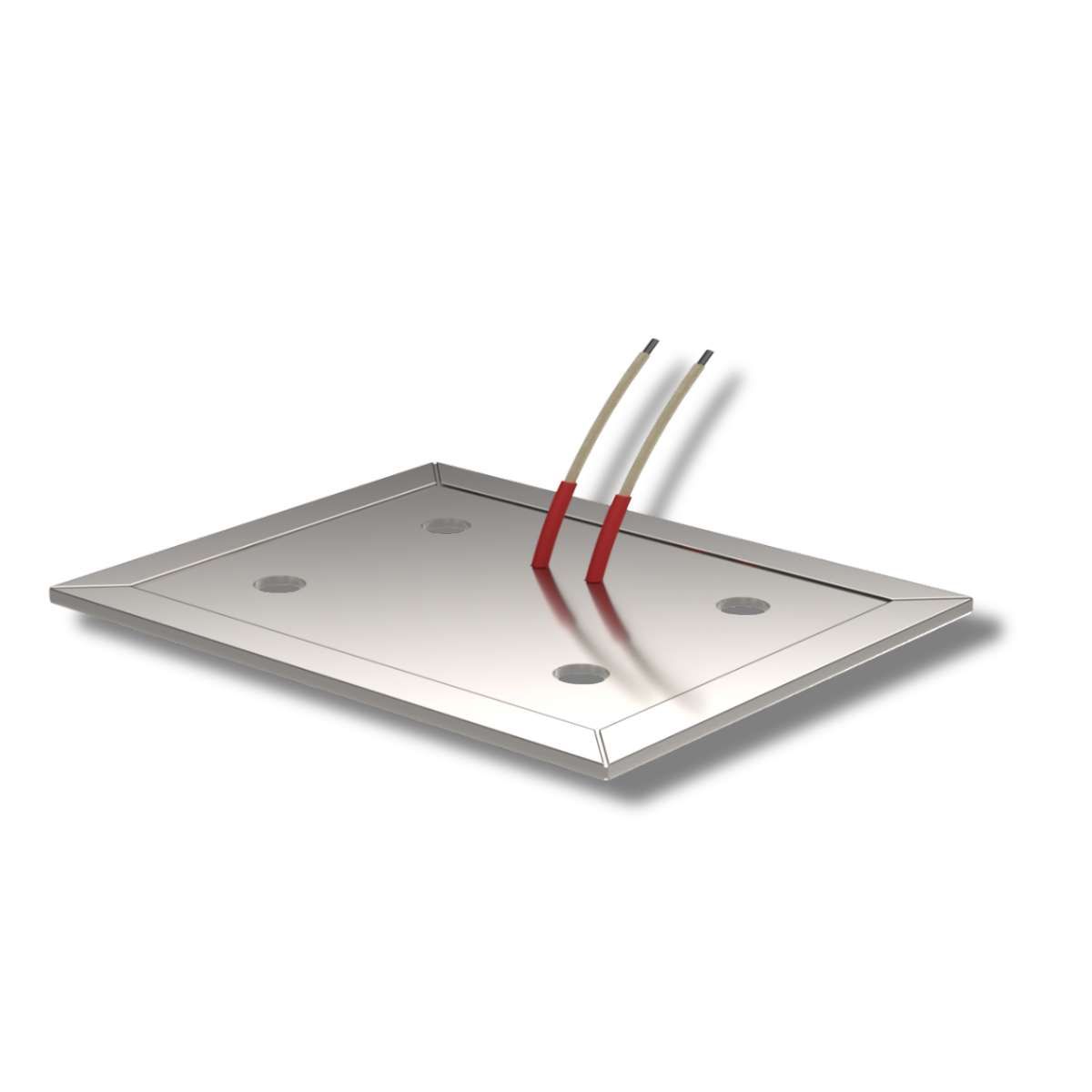
Plate Heater
A plate heater is a wide flat element that heats an area rather than a line. A resistance circuit is spread across a rectangular plate — clamped between metal sheets or cast into aluminium — so the whole face comes up to temperature together. It is used under vessels, moulds, tables and heated surfaces.
Heat Press Heater
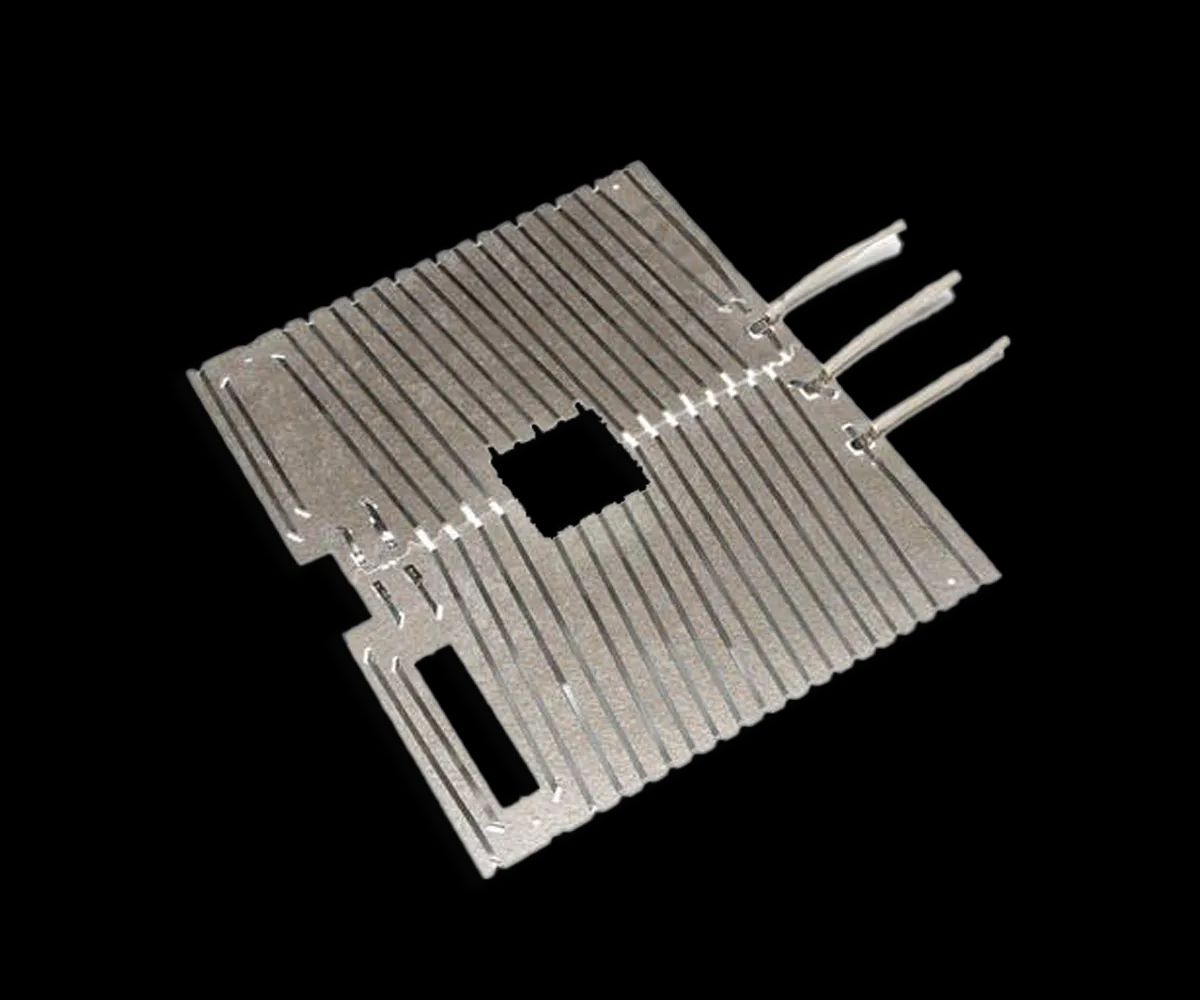
A heat press heater is the element built into the platen of a press — a heat transfer press, a laminating press, a hot stamping or a vulcanising machine. Its whole job is an even temperature across the pressing face, because everything the press makes is only as good as the coldest corner of that face.
Ask for a Price or Technical Advice
Call us or send a WhatsApp message for a price, full specifications, or a custom build.
Last updated: