Silicon Carbide Heater
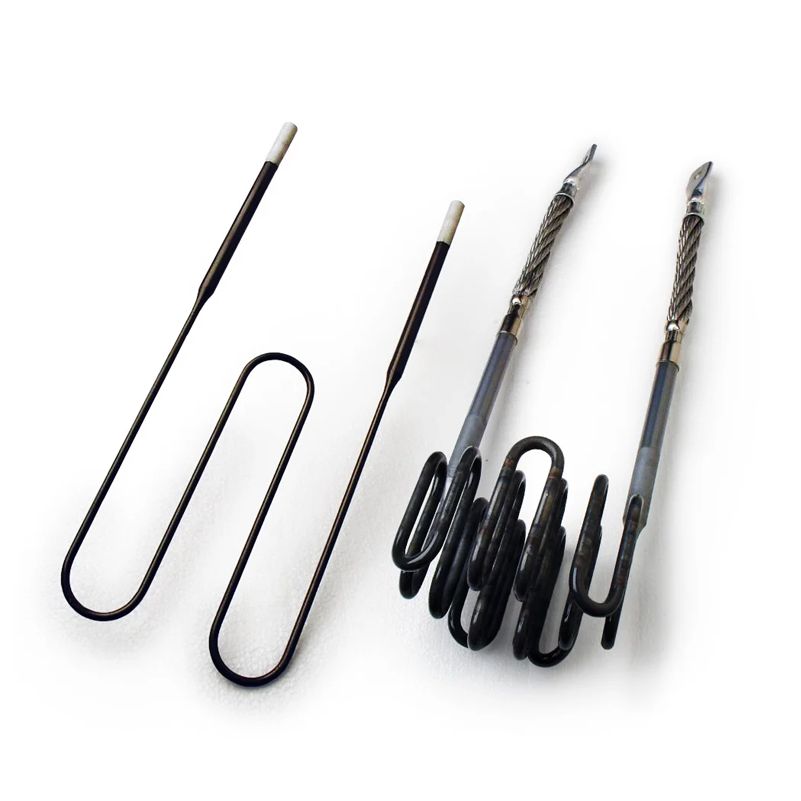
A silicon carbide heater is a ceramic rod that glows in open air at furnace temperatures up to about 1600 °C. It has no sheath and no wire — the rod itself is the resistance. It ages by slowly gaining resistance, so the furnace that runs it needs a transformer with tappings from the start.
- Max furnace temperature
- up to 1600 °C
- Atmosphere
- Works in open air
- Shapes
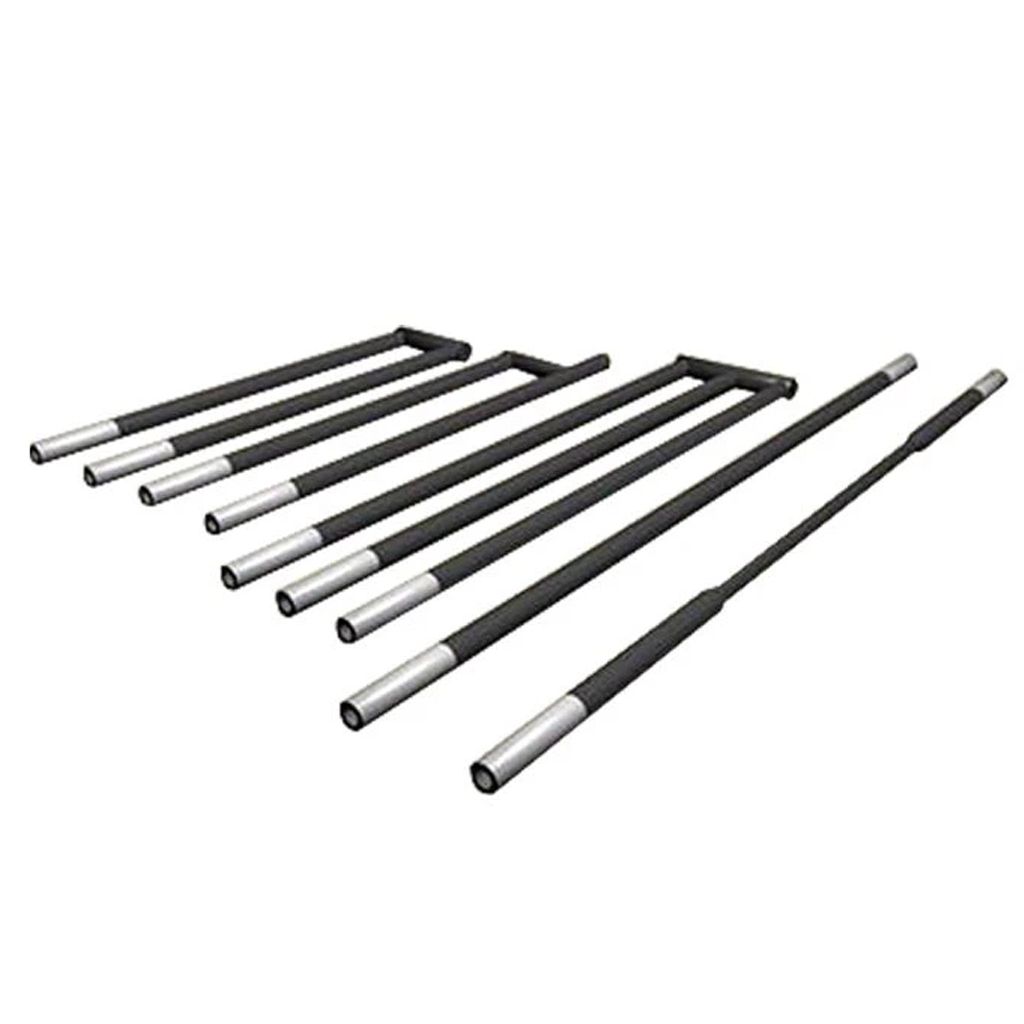
- Rod, dumbbell, U shape
- Supply
- Transformer with tappings
- Ages by
- Rising resistance
- Custom builds
- To your hot zone and cold ends
Ask for a Price or Technical Advice
Call us or send a WhatsApp message for a price, full specifications, or a custom build.
Technical Specifications
The figures below are the usual ranges for this type of element. Builds outside them are possible.
| Property | Value |
|---|---|
| Construction | A recrystallised silicon carbide rod, with a hot zone in the middle and lower-resistance cold ends |
| Max element temperature | 1600 °C |
| Usual furnace temperature | 1000 to 1450 °C |
| Atmosphere | Air, and most oxidising atmospheres |
| Rod diameter | 12 to 55 mm |
| Shapes | Straight rod, dumbbell (thicker cold ends), and U shape |
| Electrical supply | Step-down transformer with several tappings, low voltage and high current |
| Ageing | Resistance rises in service; power is restored by moving up a tapping |
| Contact ends | Aluminium sprayed, with braided straps and clamps |
| Mounting | Through the wall on ceramic bushes, free to expand |
| Spacing | At least twice the rod diameter from wall and workpiece |
Where It Is Used
- Industrial furnaces and ovens
- Laboratory equipment
- Ceramic and porcelain kilns
- Glass annealing and forming
- Heat treatment and hardening
- Brazing and sintering
Choosing, Fitting and Looking After It
Ageing is the defining property, and the furnace has to allow for it
A silicon carbide element does not fail one morning. It gets steadily more resistive over months as it oxidises in service, and at a fixed supply voltage that means steadily less power. The symptom is a furnace that takes longer each season to reach temperature, and it is very often chased around the control panel for weeks before anyone measures an element.
Design for it from the beginning: a step-down transformer with several tappings, and a routine of measuring each circuit’s cold resistance once or twice a year. When the numbers say so, move up a tapping and the furnace is back to its original performance.
Never put a new element into an old circuit
Because elements age, the ones in service are not interchangeable with new stock. A new low-resistance rod in a parallel bank of aged ones takes far more than its share of the current and burns out quickly. In series, it takes too little and leaves a cold spot. Replace a whole circuit at a time, or buy replacements matched by resistance to what is already there.
Suppliers group new elements into resistance bands for exactly this reason. Note the band when elements are fitted, and keep spares from the same band together.
Most failures are at the contact ends
The hot zone in the middle usually outlasts the ends. The cold end is where a sprayed aluminium contact, a braided strap and a clamp all meet, and oxide grows between them. A slightly loose clamp heats a little, which grows more oxide, which heats more, until the end of the rod burns off — and the element is scrapped for a fault that had nothing to do with the ceramic.
Clean and re-tension every clamp at each service, keep the terminal area ventilated and free of dust, and never leave a strap hanging on a rod’s own weight.
Treat them as ceramics, because they are brittle
Silicon carbide rods break from levering, from being clamped too hard, and from their own weight if they are unsupported over a long span. Support long rods, or mount them vertically. Let them hang free so they can grow in length. And if a rod has bonded to its bush with kiln deposits, work it loose rather than forcing it — the rod will lose that argument.
Spacing keeps everything alive
At 1500 °C a rod radiates fiercely at whatever it can see. Too close to the lining and it overheats the brick; too close to the work and it marks it; too close to another element and both run above their design temperature. Keep at least twice the rod diameter clear all round, and remember that a load stacked against an element in a kiln is a hot spot for both of them.
Atmosphere shortens or lengthens the life
Silicon carbide is happy in air, which is its main advantage. What it does not like is a furnace full of alkali vapours, halogens or reducing gases — glaze volatiles, salt, some fluxes. If elements in one kiln consistently last a fraction of the time they do in another, the difference is usually what is being fired, not the elements.
Price
Price
The price for this product depends on the specification you order.
What Sets the Price
- Diameter and length
- Power and voltage needed
- Sheath material (stainless steel, brass and so on)
- Termination type and lead or thread length
- Whether a thermocouple is built in
- Order quantity
How It Compares
Silicon carbide against the elements on either side of it.
| Feature | Silicon carbide | Coil | Molybdenum disilicide |
|---|---|---|---|
| Max temperature | 1600 °C | 1400 °C | 1800 °C |
| Works in air | Yes | Yes | Yes |
| Ageing | Resistance rises steadily | Slow | Little |
| Cost | Medium | Lowest | Highest |
Common Questions
Why does a new silicon carbide element cost the furnace more power over time?
It does the opposite — it delivers less power over time. The rod oxidises slowly in service and its resistance climbs, so the same supply voltage pushes less current. The furnace gets slower each year until the transformer tapping is moved up.
How do I know when to change the tapping?
Measure the resistance of each circuit once or twice a year, cold, and keep the numbers. When the resistance has risen enough that the furnace is noticeably slower to reach temperature, the next tapping restores it. Guess work here is what leaves a furnace running at half power for months.
Can I replace one element in a set?
Only with one matched to the resistance of the elements already in that circuit. A new element among aged ones takes the wrong share of the current — too much in parallel, too little in series — and it burns out or leaves a cold zone.
Why are the ends of the rod a different diameter?
That is a dumbbell element. The thicker ends have a much lower resistance, so they stay comparatively cool where they pass through the furnace wall and reach the clamps. The heat is made only in the thinner hot zone in the middle.
What is the aluminium coating on the ends for?
It is the electrical contact. Sprayed aluminium gives a low-resistance surface for the braided strap and clamp to grip. Keep it clean and the clamp tight — a poor contact there heats, oxidises, heats more, and burns the end off the element.
How should the rods be mounted?
Through the furnace wall on ceramic bushes, hanging free inside so they can expand. They must not be clamped rigidly at both ends and must not touch the lining, the work or each other. Long rods are usually mounted vertically so they do not sag.
Related Products
High Temperature Heater
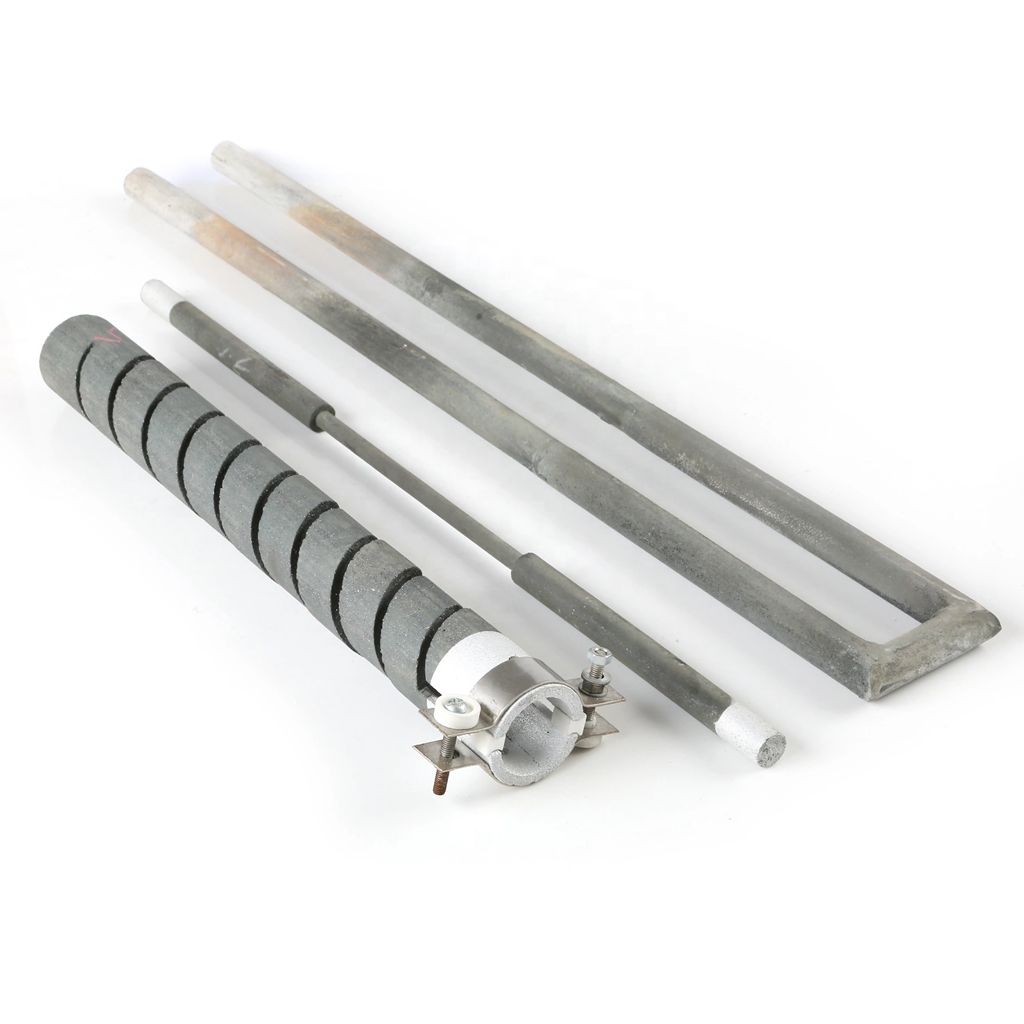
A high temperature heater works above the range where an ordinary sheathed element survives — roughly 1000 °C and up. Silicon carbide rods, molybdenum disilicide elements, open resistance coils and molybdenum heaters take furnaces and kilns from 1000 °C to about 1800 °C, and each one is chosen as much by the atmosphere inside the furnace as by the temperature.
Ceramic Heater
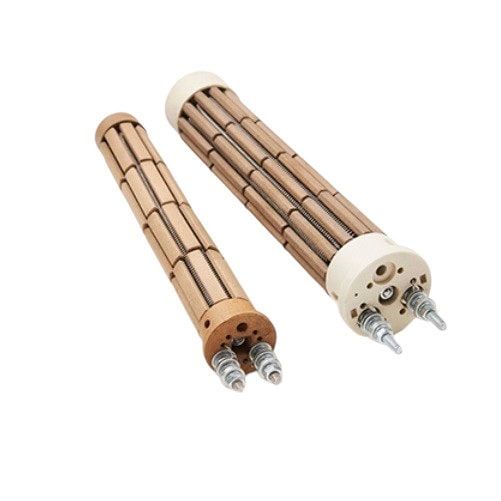
A ceramic heater for high temperature work carries its resistance wire inside a ceramic body rather than leaving it bare in the chamber. Wire threaded through ceramic tubes and beads, or set into a fibre module, reaches about 1200 °C while staying protected from the load and from what the furnace gives off.
Furnace Heater
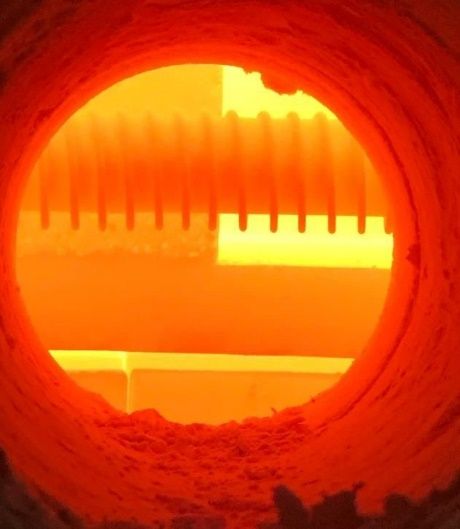
A furnace heater in its simplest form is an open coil of resistance wire laid in grooves in the lining or hung on ceramic supports inside the chamber. Iron-chrome-aluminium wire reaches about 1400 °C, nickel-chrome about 1200, and the coil is wound and pitched for the furnace it goes into.
Molybdenum Heater
A molybdenum heater is a wire, strip or rod element for vacuum and inert-gas furnaces. It reaches about 1700 °C, but only where there is no oxygen — molybdenum burns away in air above roughly 400 °C. It is the element used for sintering, brazing and crystal growing under vacuum.
Ask for a Price or Technical Advice
Call us or send a WhatsApp message for a price, full specifications, or a custom build.
Last updated: